
RASTRACK App: the lead arrived in the WhatsApp. Who answers and accompanies?
A guide to organizing conversations, stages of the CRM, tasks and responsible in the RASTRACK App, separating the existing interface from the still planned functions.

The lead sent message in the WhatsApp. Who answers? Who assumes if the first person leaves? And where is it recorded what needs to happen tomorrow? A conversation may appear under control while it is open on an attendant's screen. The problem appears in the shift exchange, the promised return and the tasks that no one has claimed.
The RASTRACK App looks at this routine of attendance and follow-up. He gathers chat, CRM, tasks and team vision so that each conversation has context and next step. It is not the same question as RastrackDash WhatsApp, which mainly accompanies the origin of the conversation and the path of the lead from the campaign.
One example: the agency needs to continue the conversation
Imagine an agency serving the WhatsApp of three customers. On Monday morning, a contact asks about an offer. A person on the team responds and promises to submit a proposal after confirming a business condition. In the afternoon, that person leaves. On Tuesday, another attendant takes over.
If the only reference is the last message sent, the new attendant does not know who confirms the condition, whether the proposal has already been produced and when it should return. The lead you can get the same question again or stand still. I would arrange the work in four records: the conversation, the stage where the contact is, the pending task and the responsible person. The step helps to locate the contact in the process; the task says what needs to be done; the person responsible is responsible for doing or redistributing.
The path of care
The arrows represent the working sequence, not a promise that the system sorts and executes everything itself. Someone needs to keep the right step, complete the task, and record an important change in history. If the team skips this discipline, the visual frame only organizes outdated information.
What does the interface allow you to see
The editorial capture of the CRM show Real components of the project: frame with pipeline steps and cards of leads. It was mounted at a temporary checkout from the app code. A capture route was added only to render these components without actual authentication. The six leads and the four steps shown in the dark version were simulated in the browser, not extracted from customers or from an operation in production.
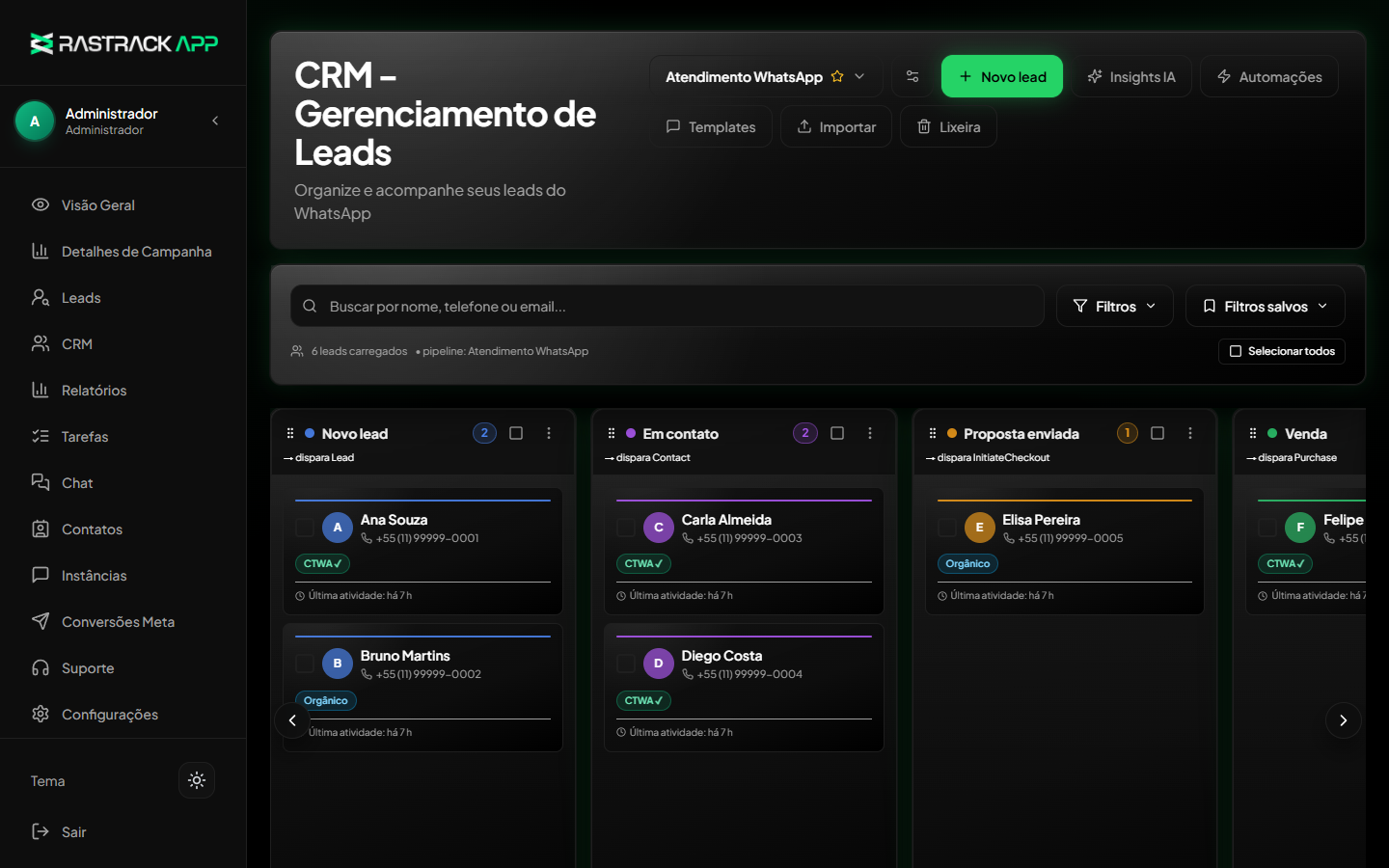
CRM do RASTRACK App em tema escuro, com seis leads fictícios distribuídos em quatro etapas do Kanban.
Print is useful for understanding how the team can see the steps. Him does not prove that the leads represented were taken care of, that a task was completed, that a customer improved their response time or that all streams are working end-to-end. To verify this, I would need to follow a real conversation, confirm the assignment of guardian and observe a task until closing in the correct environment.
Where does the dashboard end and start the service
If the question is “what ad generated this conversation?”, the RastrackDash WhatsApp is the project focused on reading origin, stages and events. If the question is “who will answer and what is left to do?” the RASTRACK App organizes the team’s work. These readings may be useful in the same operation, but this It does not prove automatic integration between the two applications.
Another major frontier is chatbot. It appears in the planning as an evolution of the RASTRACK App. I will not present an automatic response as a ready-made feature just because there is chat and CRM in the interface. Answering, suggesting response and sending automatically are different capabilities. Each requires rules, permissions and tests of its own.
How would I check if the routine has improved
It would start with a small sample of conversations with different situations: a new one, one that expects return and another that has already been completed. I would ask someone who did not participate in the first care to open each case. Can this person understand the history without asking the colleague again? Does the stage correspond to what happened? Is there a clear task for the next movement?
Then I'd look at the stopped conversations. A card in a column does not guarantee that the next step is set. You may lack responsible, deadline or information to take action. The team needs to have a rule to redistribute the case when someone is absent. This is the kind of problem that the app should make it easier to see; it doesn’t add up just because the conversation has won a label.
A practical checklist for the operation:
- Does the conversation have enough context for someone else to take on?
- The stage of the CRM describes the real state, and not just an intention?
- The task says what to do, by whom and when to review?
- A promise made to the lead does it appear in the work register?
- Can the completion of the task be conferred in the conversation or in other evidence?
I would use the RASTRACK App when the volume of attendances or the size of the team make it fragile to depend on the individual memory. The gain sought is not to have one more colored picture: it is to make the next person know what has already been done and what remains to be done.
This is one of 13 apps and projects from my general guide, which separates data, attendance, operation and the actual stages of each project.
Frequently asked questions about team use
Does the RASTRACK App single-handedly identify which ad generated the conversation?
That is not the promise of this guide. Here the focus is the work after the message arrived: conversation, step, task and responsible. The origin reading of the campaign is the problem dealt with by the RastrackDash WhatsApp. To unite these views in an operation, it would be necessary to specify and verify the passage of data between projects.
The chatbot already automatically responds to the lead?
I don't present the chatbot as a ready function. It appears as planned evolution. Even with an inbox and an CRM visible, suggest an answer, submit it to the review and send it automatically are distinct steps. Each would need business rule, permission and proof of their own before entering the service routine.
What is the first test you would do with the team?
I would choose three conversations and ask an attendant who did not participate in them to say, without outside help, what happened and what is the next step. If you can’t, you’d check if there’s a lack of history, step, task, or guardian. This exercise shows where the process depends on individual memory and gives a concrete criterion for evaluating the interface.