

PalmUP Platform: when the sale happens, the financial knows?
Contact, offer, sale and financial need to be part of a coherent reading. See the proposal of the PalmUP Platform and what a screen with demo data actually proves.

The CRM he says there was a sale. The gateway shows a payment. The financial records another amount after the fees, and the person who bought it appears with a different name in a spreadsheet. Which of these screens tells the correct story? The answer is not to choose the most beautiful panel; it is in being able to connect contact, offer, sale and financial record with evidence.
A PalmUP Platform brings these fronts closer together in a management vision. The project brings together context of contacts, products, offers, service, sales, financial and media data. The question that guides the use is practical: After a person enters the operation, can I keep track of what was offered, what was sold and what did the financial recognize?
A precise sale of context
Imagine a person arriving as a contact, talking to the team, receiving a course offer and completing the purchase. The following week, it calls for cancellation. If the CRM only registers “sold”, the commercial view remains positive while the financial already needs to treat a refund. If the financial only sees a transaction, it may not know which offer and what service is behind it.
I would start with the simplest path: identify the contact, record the offered, check the sale with a reliable identifier and locate the corresponding financial release. Then it would treat the exceptions: pending payment, installments, cancellation, refund or purchase by another channel. These edges reveal whether the vision actually helps the team or whether it only sums up numbers that don't have the same definition.
The question runs through four records
The arrows represent a sequence of analysis, not a statement that every external system is already integrated. In each passage, it is necessary to know which identifier unites the records and what to do when the link is missing. Without this rule, “recipe of the CRM“and “financial revenue” may seem to disagree when they’re just telling different things.
What the image of PalmUP show
The available editorial image is not a print of the actual result of an operation. She's one faithful reconstruction of the interface from the current project code: visual identity, theme, widget structure, labels and order of indicators. The values displayed were filled with a fictional fixture. The local environment did not allow to perform all migrations to capture the live panel; therefore the composition reproduced the visual components in local HTML.
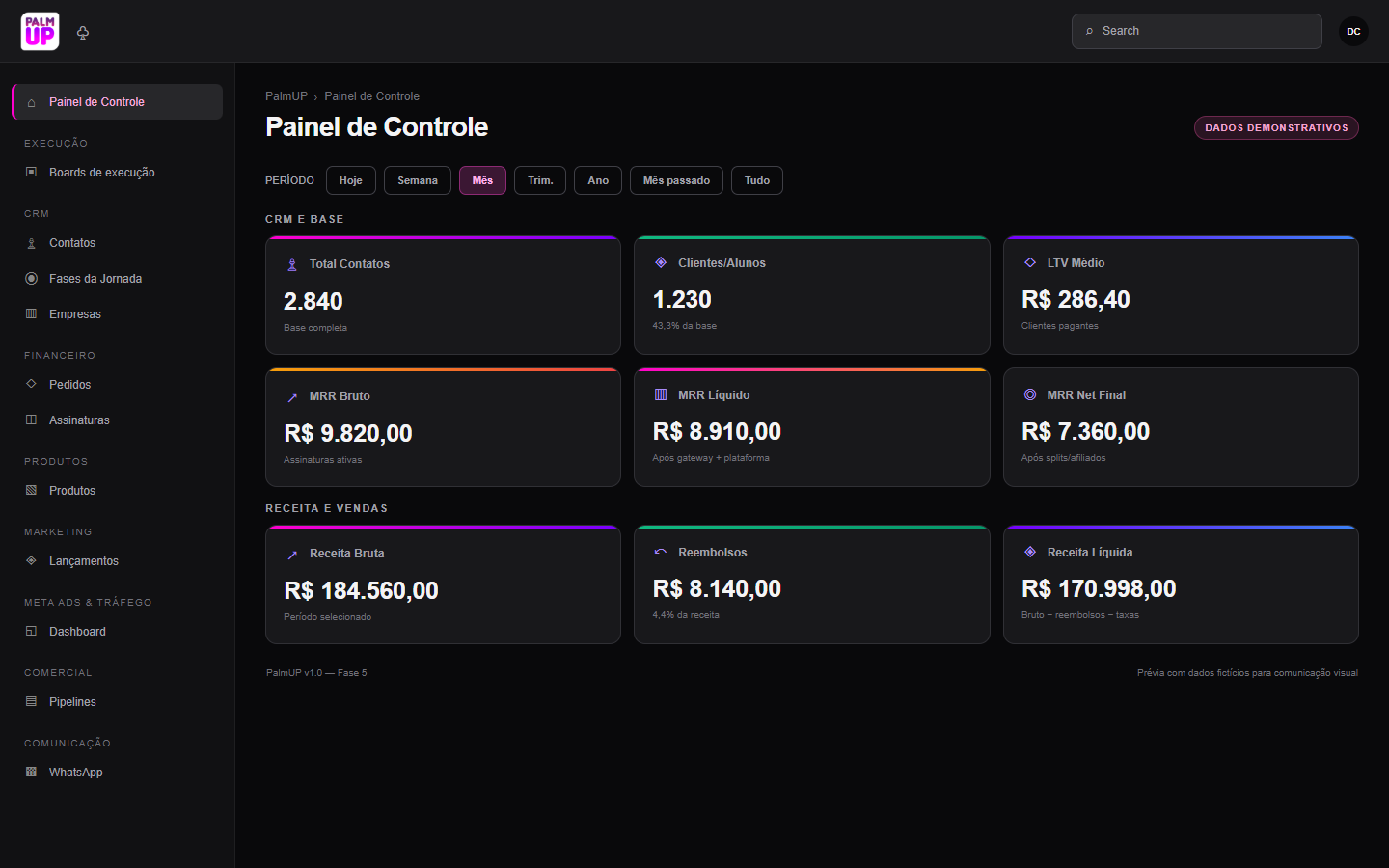
Reconstrução visual da PalmUP Platform a partir do código, com cartões de CRM e financeiro preenchidos por números fictícios.
I would use that look to explain which areas does management intend to put side by side. I wouldn't use the numbers to affirm billing, growth, customer LTV or campaign effectiveness. A “net revenue” card on the interface does not prove that cancellations and fees have been reconciled in all sources. Interface drawn, flow working and proven result are different levels of evidence.
The test I would do before I relied on vision
I would choose a sale that can be checked off the panel and would go the way back. Does the contact correspond to the right person? What offer did she receive? Does the order have the same identifier in the sale system and in the financial system? Is the amount shown gross, net rate or already discounts refund? On what date does each system consider that the sale happened?
Then I would repeat the test with a case of exception. A payment that has failed, an organic sale without an identified campaign, or a refund after several days helps reveal rules that the perfect example hides. When a step cannot be safely turned on, I would leave the gap visible. Inventing an association to complete the chart makes the decision worse.
It would also compare the same period in two readings: orders created and payments recognised. If a sale was started on the last day of the month and paid on the first day of the following month, the totals may be different without any system being wrong. The team needs to state which event it uses for each indicator. Thus, a result meeting ceases to be a dispute between screens and becomes a discussion about definitions.
This care also separates the PalmUP of a panel focused on the origin by the site. The RastrackDash Info observes campaign, event, lead and sell on the digital journey. A PalmUP opens the management question Then and around the sale, including supply and financial. The two readings can coexist in an operation, but I do not assume that they share bank or automatic integration.
Checklist for a reliable management view
- Does the contact have an identifier that does not depend only on the name typed?
- Is the offer presented linked to the correct sale?
- “Sale” means order created, approved payment or cash received?
- Does gross revenue, fees, refunds and net income have clear definitions?
- Do outstanding payments and cancellations appear in the appropriate period?
- Can the team return from the aggregate number to a verifiable case?
If these questions are not resolved, I would start by organizing the records, not by adding one more chart. The purpose of the PalmUP Platform is to give context for a decision. The validation of each module and each connection needs to keep up with this ambition.
This project is in the Guide of the 13 apps and projects I created with Claude Code and Codex, with the stages and differences between the tools.
Frequently asked questions about management view
The numbers shown in the print are the results of PalmUP?
No. No. The values of the image are fictional, used to demonstrate the visual structure of the reconstructed interface from the code. They do not measure revenue, net revenue, growth, or campaign performance. To present a real result, it would be necessary to identify the period, the source of the records and the calculation rule of each indicator.
Why CRM and financial can show different values?
They can count different events. The CRM can register an order as sale when the proposal is accepted; the financial can recognize the payment on another date, discount fees and register a refund later. The comparison only makes sense when each screen declares what it calls a “sale”, what period it uses and how it treats cancellations and installments.
A PalmUP already automatically integrates all these sources?
The look and the management proposal do not prove this. An integration needs to be verified registration by registration, including pending payments, organic purchases and refunds. I would start with a real case that can be traced from contact to financial release and would explicitly mark any link that does not yet have evidence.