

Direct Attendance: who saw the message and what is the next step?
Direct Attendance is a pilot to arrange messages received from the Instagram, history, notes, steps and human review. Understand what has already been demonstrated and the shipping limit.

One person asked about a service by the Instagram. Another answered the first message and promised to return later. The next day, those who open the conversation need to know what has already been said, what has been agreed and who answers now. If it depends on a person's memory, Direct can become an invisible queue.
Direct Attendance is an pilot to organize incoming messages, history, notes, steps, and next steps in an inbox. The answer can be prepared for human review. It is a useful work drawing, but its current state needs to be explained carefully: the actual receipt has already been registered; the sending of responses to ordinary customers still depends on permission from the Meta.
The problem that inbox helps you see
Imagine a small team answering messages from a campaign in the Instagram. Larissa asks about a class, asks for a time to talk and says she can only do it after work. One team person reads, but needs to confirm availability with another. With no note and step, the conversation may seem “answered” because there has already been a message, although the return commitment remains open.
I would arrange this case in three layers. The History It shows what the person actually sent and what the team has already done. A internal note save the information that helps the next attendant, without putting a behind-the-scenes phrase in the customer response. A stage indicates the operational state: for example, awaiting revision or return. Only then would I prepare an answer, for someone to review before any submission.
Internal work in the pilot
Read the message
Understand the request and history.
Register a note
Save the context for the team.
Define the step
Make the next move visible.
Prepare response
Write without assuming automatic submission.
Reviewing with a person
Check before external action.
This flow ends in the Human Review. The infographic does not include a “delivered message” arrow because this capacity for ordinary customers has not yet been proven in the intended use.
How to read print without confusing simulation with production
The cured capture shows a app interface run locally, not a redesign. It was made in a temporary instance with SQLite bank in memory and empty environment. The four contacts and the six messages received were created by the simulation flow of the app itself. The selected conversation had three messages; note, review step and draft were filled in the interface. No response was recorded or sent in that demonstration. The bridge n8n remote AI was disabled.
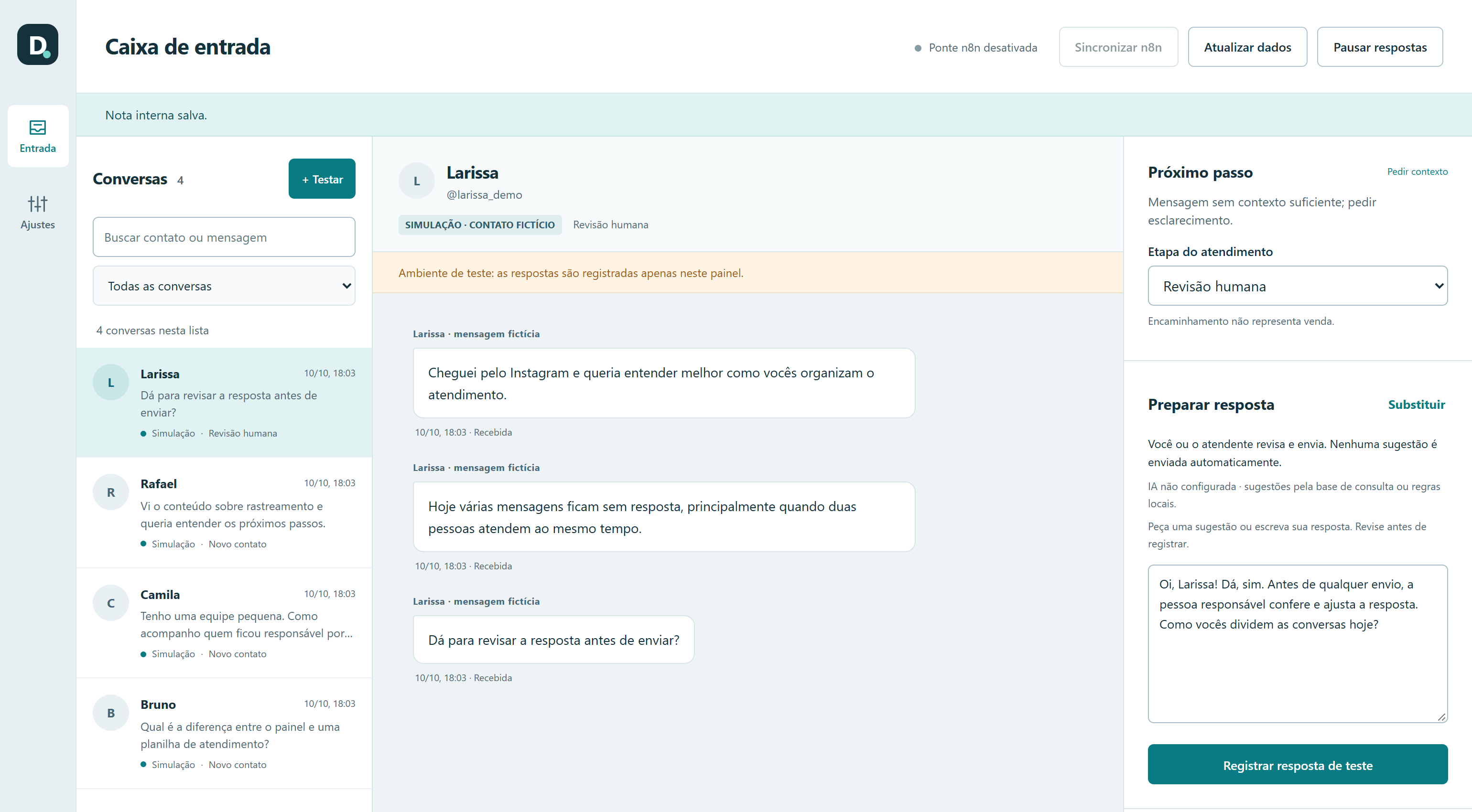
Inbox do Direct Atendimento em demonstração: conversas fictícias, histórico, etapa de revisão humana e rascunho não enviado.
Print is used to evaluate organization and readability: where the conversation appears, if the history helps, how the note is separated from the external message and whether the next step is easy to find. It does not demonstrate that a real customer has received a response, that a robot responded alone, or that integration with Meta is cleared for any account.
Receive, prepare and send are three different proofs
This separation matters in any service automation. Receiving a message does not automatically give the right or ability to respond by the application in all scenarios. Preparing a draft also does not equate to registering a shipment. And a local interface with fictitious data does not replace permission verification and testing in an authorized account.
To extend the pilot, I would have to confirm the scope of the Meta’s permission applicable to shipping to ordinary customers, exercise the allowed flow, and record the result. Then came operational validation: who can approve a response, how to avoid duplication, how to identify a conversation that was left with no return and what to do when the integration fails. Until these steps are proven, the honest description is inbox in pilot with human review.
The RASTRACK App face a similar question in the WhatsApp: context, stage, task and responsible. This is not to say that the two tools share conversations or integrations. These are different channels and design stages.
A small test before relying on the routine
I would start with a conversation received in the pilot's permitted scenario. I would ask someone else on the team to open it without receiving a summary on the outside. Can she identify the request, the history and the note? Can you tell what the current step is and which answer needs revision? If you can’t, the first problem is clarity of operation, even before discussing automation.
Then it would check an exception situation: two people opening the same contact, a note that was outdated and a promised return for tomorrow. Does the system help you see the risk or do you only display the last message? This question guides the next iteration.
Checklist to evaluate the pilot without extrapolating:
- Does the message received match the history shown?
- Is the internal note clearly separate from the external response?
- Does the stage describe the next real step?
- Is the draft reviewed by anyone before any shipping action?
- Does the Meta permission and the result of a shipment, when tested, have evidence of their own?
If the final answer still depends on external permission, I would not skip that line in the article or the demo. The current utility of Direct Attendance is in making the conversation reviewable and the queue visible; the ability to respond widely comes only when it is authorized and tested.
The project appears in the Guide of the 13 apps and projects created with Claude Code and Codex, with the different stages identified.
Frequently asked questions about the pilot
Does the print show messages from real customers?
No. No. The interface was executed locally, and the conversations displayed were created by the simulation stream of the app itself. Print helps evaluate the organization of inbox, history, notes and draft. The actual receipt was recorded in another stage of the pilot; the editorial capture is not proof of this receipt.
The app can answer anyone in the Instagram?
There is no such validation yet. Shipping to ordinary customers depends on applicable Meta permission and testing in an authorized scenario. A ready-made text in the interface is just a draft. To claim submission, I would need evidence of the outcome in the target account, plus rules for review and treatment of failures.
What can a team evaluate now?
She can check if another person understands a conversation without asking for context on the outside: what was the question, what note is internal, what stage the service is in and which answer awaits review. This clarity test is valuable even before you automate shipping. It also reveals when a step or a note does not help decide the next move.