

RastrackIA: Before the script, understand what the page needs to measure
See how to start from the URL and the actual journey to set up the collection in RastrackIA, generate an artifact, and test the result without promising complete automation.

Before installing any script, I would ask: What action on this page needs to become reliable information? The button of the WhatsApp, a submitted form and a checkout purchase are different actions. If I copy a configuration from another page without understanding the journey, I can end up with beautiful events in the dashboard and little ability to explain what happened.
RastrackIA organizes the beginning of this work. The dashboard allows you to add a page's URL, track captures, and open projects. The script delivery and instructions come after the setup. This sequence is useful, but it is necessary to separate Page added, Capture ready, generated file, declared installation and Observed event. A state does not automatically prove the following.
An example of a course page
Consider a fictional page with three outputs: the person can click to talk about the WhatsApp, submit a form or go to an external checkout. Before opening RastrackIA, I would put together a test plan:
- Click on the WhatsApp: observe the button and destination triggered. Then check if the conversation has arrived and if the origin has been preserved.
- Form: observe the completed submission, not just the focus on the field. Then check if the lead entered the base with consent and without duplicate.
- Purchase: observe approved order and reconcilable identifier. Then check if the request exists on the platform and connects to the correct journey.
This table is not an app report; it is the test plan. The page can load components after interaction, change URLs, or forward to another domain. A screenshot helps you see the structure, but it doesn’t single-handedly discover all business rules or validate the checkout webhook.
States that should not be confused
URL added
The page entered the project.
Capture ready
There is material to inspect the interface.
Configuration saved
Platform and options have been registered.
File generated
The script and instructions are available.
Test observed
Real actions produced events conferred in the destinations.
What does the screen show today
In the secure capture of the dashboard, based on the product frontend, I see the field URL of the page, the button Add page, the cards of domains, pages and ready-made captures, plus the list Recent activity. It shows example projects with states like “Ready to analyze” and “Incomplete Captures.” The numbers and domains of this image are fictitious; they serve to present the interface, not to prove use or commercial result.
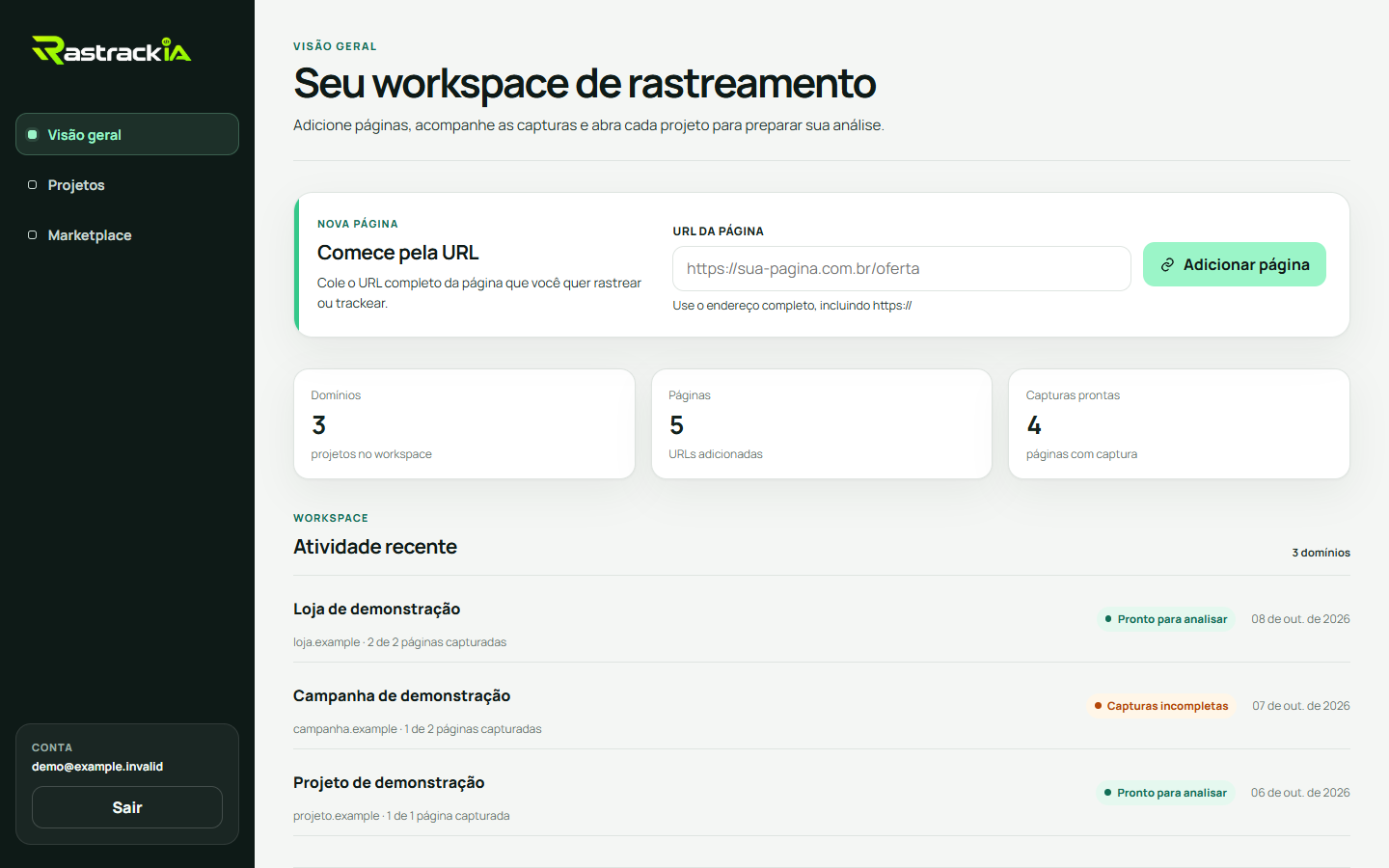
Dashboard demonstrativo do RastrackIA com URLs e contagens fictícias; não comprova script instalado.
The audit documentation of the project itself shows a limit that I would not hide. In the authenticated test recorded in September 2026, click on “Analyze page (optional)” returned unavailability of the analysis; no confirmation questions appeared to the student. The code provides for suggestions, but the visual flow of confirming the analysis was not yet complete in that test. That’s why I wouldn’t write “AI automatically chooses the right modules” as a validated function for all users.
The same audit found model files GTM Web and Server in the local collection, but no pair published in the administrator in that moment. The student did not have a Web + Server + journey Stape demonstrated from end to end in this environment. Generating and copying a script is a different delivery from importing a container, publishing the GTM and observe the purchase coming to the destination. These states can evolve with the project; this description is related to what has been verified.
The test that turns archive into evidence
- It would open the URL and confirm that the capture matches the right page and the current version.
- It would only set up the options I can justify. If the checkout is external, it would note which parameter should take the identifier and what the webhook returns.
- It would generate the file and store version and hash of the delivery. “Script generated” is the name of this milestone.
- Installed in a test environment, open the browser and trigger each action of the frame: click, form, exit to checkout and test purchase when possible.
- Would compare the events collected on the basis itself with the Preview of the GTM and, if there is stack server configured, with the server destination. Duplicates, empty fields, and exchanged IDs are flaws even when the event appears.
- I would only call the implementation of validated after reconciling the request at checkout with the journey and documenting the steps that were left without proof.
If the purchase appears in Meta, but I can't find the order that sustains it, I still have a data problem. If the order is on my basis and the submission to the Meta fails, the investigation is another. First-party data collection collects and stores information on its own basis; conversion tracking Report the data to the traffic platform. The first-party data collection leaves the person smart. The conversion tracking leave the platform smart.
RastrackIA can arrange preparation and technical delivery. The responsibility for testing behavior on the site and destinations remains explicit. No map of 13 projects I created with Claude Code and Codex, it appears among the tools that prepare the collection; the RastrackDash Info then looks at the recorded journey.
Frequently Asked Questions
Does a ready-made capture mean the script is installed?
No. No. It shows that there is visual material to analyze the page. There is still a lack of configuration, file generation, installation and testing of each action that interests the business.
Can I copy the script to all pages?
I would review each journey. Buttons, forms, checkout domains, and consent rules vary. Reusing without checking selectors and destinations can create duplicate event or assign a purchase to the wrong page.
What is the minimum criterion for calling the collection of validated?
Run a test journey and locate the expected events on their own base, without duplicates and with coherent identifiers. If you send to a platform, check this step separately. In the case of purchase, reconcile with a real trial order at checkout.