
NODTeam: who reviews the work when multiple agents work together?
Get to know the visual HQ of NODTeam, how it represents squads, tasks and human review, and which parts are still demonstrative.

When multiple AI agents work at the same time, the question is no longer just “who can write faster?” I need to know who received each task, what context it used, what result it delivered and who approved the next action. Without it, two people can review different versions and a draft might seem ready just because an agent has closed its part.
NODTeam is the design of a HQ to make these passages visible. The frontend already shows a view of squads, cards, and recent activity; the repository also contains a API. Still, he is in development. The capture of the interface was done with the offline backend and fixed data of the frontend itself. It proves the visual design of the HQ, not that dozens of agents are performing real tasks.
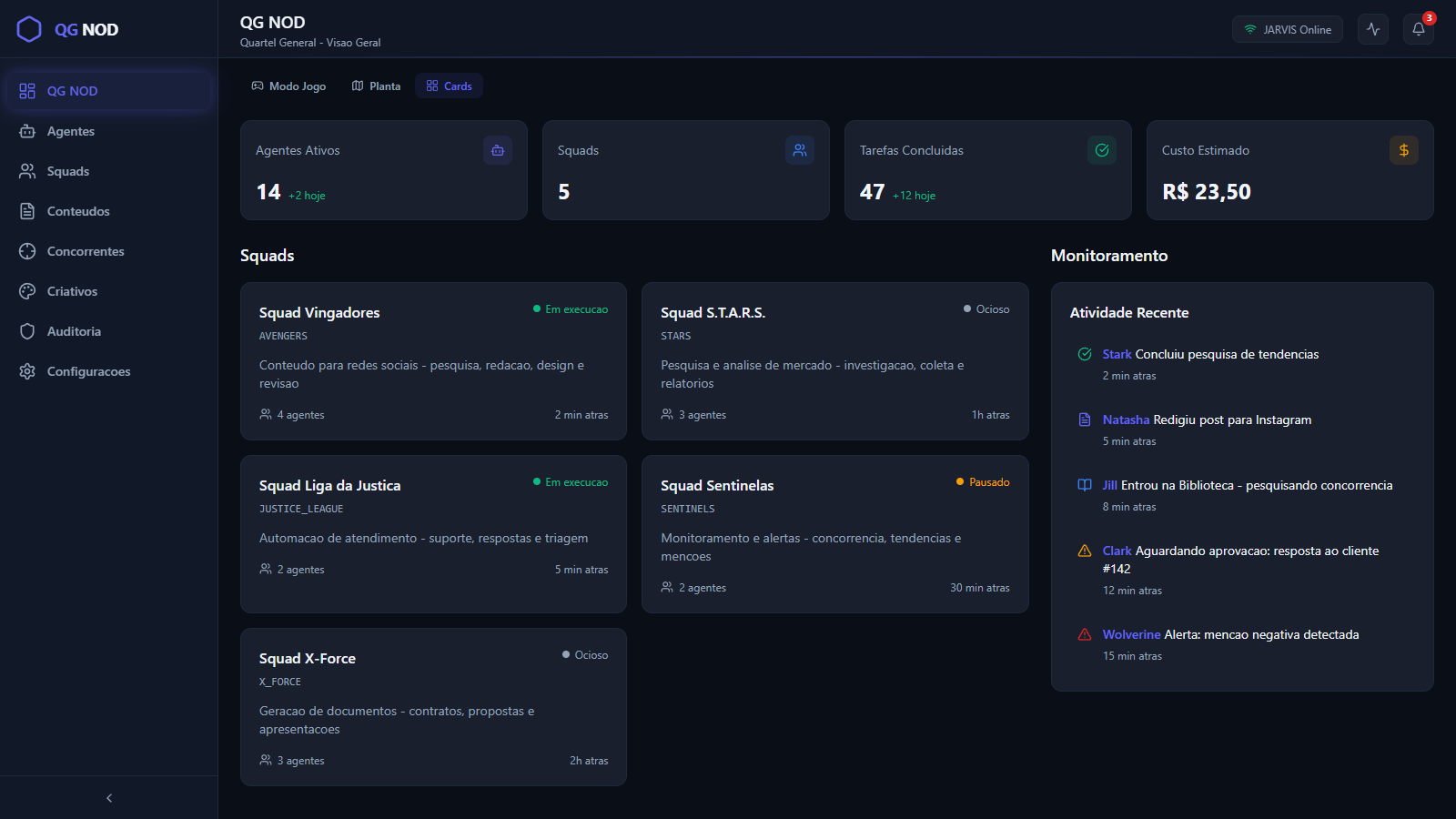
Interface demonstrativa do NODTeam em desenvolvimento com squads e indicadores fictícios; backend não conectado na captura.
What does HQ show today
The Cards screen separates a summary at the top, the squads in the center and a monitoring panel on the right. The cards of the squads exhibit focus, illustrative amount of agents and state. Navigation includes areas for agents, squads, content, audit and settings. There are controls for visualization modes called Game, Plant and Cards.
This design helps to see a possible operation. For example, a squad can take care of research, another of content and a third party of attendance. An activity requiring human decision would appear in a review queue. But the existence of these areas on the screen does not prove that forwarding, execution and approval already work end-to-end.
The route that the HQ intends to organize
Task
Define objective and responsible.
Context
Indicate current sources, limits and version.
Execution
Record output and evidence of the agent.
Review
A person confronts result and source.
Approval
Only then is the next action authorized.
How would I apply this to a series of articles
In this blog itself, an agent could locate the documentation of an app, another prepare a text, and another check whether the capture of the interface uses fictitious data. The reviewer would gather those parties, resolve disagreements and check the final article before publishing. This is an example of a desired flow, not an account that NODTeam has already published this series automatically.
There are differences that the system would need to preserve: a completed task does not mean approved article; a frontend print does not prove that an integration works; a text approval does not equate authorization to publish on all platforms. The HQ was designed precisely to make these steps and responsibilities readable.
Screen numbers are a demonstration
The capture of NODTeam displays, among other elements, agent cards, squads, completed tasks, estimated cost and recent activity. These KPIs and activities come from demonstration constants on the frontend. The number “14 agents,” for example, is not a measurement of active agents. The backend was not connected during capture.
So I wouldn’t use that image to advertise productivity, actual cost, or ready-made operation. What I can show is the proposal of interface: squads with distinct focuses, a view of tasks and a place reserved for human review. To call this flow validated, it is still necessary to test the actual actions, the persistence of the states, the record of the evidence and the blocking of actions before approval.
The idea behind NODTeam remains useful even as the project matures: contextless speed creates rework. A team of agents needs responsibility, background and a person able to say “is ready” based on proof, not just a green status.
What the image of the HQ allows you to observe
In the capture, the mode Cards is selected. There are shortcuts to Game and Plant modes, a side navigation for agents, squads, content, competitors, creatives, audit and settings, four indicators at the top and squad cards in the center. The panel on the right brings together a recent demonstrative activity. This composition is useful because it places staff, tasks, and alerts in the same visual field.
But the numbers need to be read correctly. “14 active agents,” “47 completed tasks” and “R$ 23,50“of estimated cost were filled by frontend constants for demonstration. The names and times in recent activity are also examples. None of them are evidence of actual execution or expenditure. The capture itself was made with the backend disconnected. What it documents is the proposal of the interface, not measured productivity.
Cards help to visualize different focuses: content, research, attendance, monitoring and documents. Status such as “Ruling,” “Idle” or “Paused” need to come from real events to guide an operational decision. As long as this is not tested, I would treat these labels as part of the visual prototype.
Example: produce an article without losing responsibility
Suppose the goal is to publish a guide on an application. The initial task would have title, public, canonical font, product version and deadline. A research agent could point out the documentation and record what has been confirmed. Another would create a draft. A third would check prints, fictional data, links and technical statements. The human reviewer would receive a unique package with text, fonts, image and doubts still open.
There are three locks I would require before calling the flow ready. First, each output needs to indicate What task and what source originated it, to prevent an old version from coming back by mistake. Second, the “completed” state of an agent should only mean that he has turned over his part; the editorial review remains pending. Third, publishing is an action of its own, dependent on explicit approval and a verification at the destination. A green card does not replace any of these steps.
In the imagined HQ, I would be able to return from a published article to the task, the agents involved, the human corrections and the receipt of the publication. This is the utility criterion of the product. The current interface shows where this information could appear; the persistence and execution of this track still need to be demonstrated in testing.
Checklist to validate the project before operating
- Do tasks maintain objective, responsible, source and version after reloading the page?
- Does each agent record output and evidence without replacing the work of another?
- Is a change of state auditable with author, time and motive?
- Does the review queue block critical actions until real human approval?
- Costs and activities come from observed events, not demonstrative cards?
- Does a post generate a verifiable receipt in the target channel?
Common doubts
The 14 are agents shown working? There is no such proof. The capture number is given a fixed demo.
A squad replaces the reviewer? No. No. The squad may divide tasks, but the editorial decision and authorization of the next action need a responsible person.
What is missing to call operational HQ? Validate actual execution, persistence, evidence, auditing and blocking actions prior to approval. A compelling interface is just the beginning.
This guide is part of the series 13 projects I created with Claude Code and Codex.