
How to assemble a creative machine for Meta Ads
Use briefing, variants, and ad ID data to decide the next batch of creatives. See how to compare CTR, CPA and quality of the lead and copy the initial prompt.

You open the Ads Manager and find one creative with cheap click and another with more leads qualified. Which one will guide the next batch? The answer depends on what went into the test, what action you wanted to generate, and what happened after the click.
I organize the creative machine in four moments. First enters the briefing with the proofs of the offer. Then come the creatives and a chance by variant. The approved version is linked to the ad ID. Finally, the data goes back to production with a specific decision, such as maintaining the demonstration and testing another opening. I treat viral potential as a creative hypothesis about what holds attention and makes someone want to pass on the idea. In advertisements, the result needs to be judged by the objective of the campaign.
From briefing to next lot
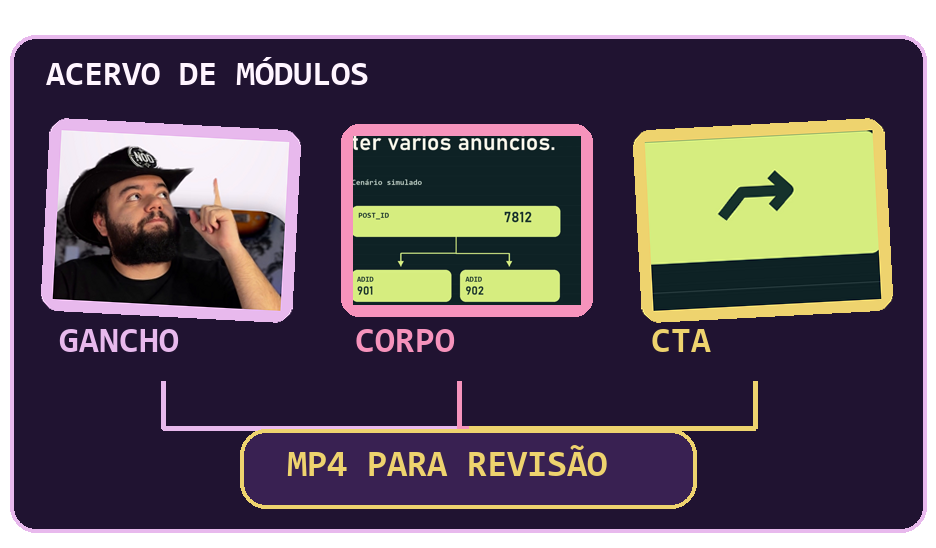
Biblioteca de gancho, demonstração e CTA organizados em módulos
*The modular format allows you to change the aperture and preserve the demonstration and call.*
1. Give AI the inputs a copywriter would need
Write on a page who you want to hit, the problem that this person recognizes, the offer, the destination of the click and the business event that is worth as a result. Gather evidence that you are allowed to use, such as a product capture or a replayable demonstration. Include terms and promises that need to be avoided. If there is data from previous campaigns, send the clipping by ad ID, with the window, the event, and the raw volumes.
Example to accompany the guide. You offer one Media diagnosis for managers who receive leads of WhatsApp and want to know which ad they came from. The CTA is “Request the diagnosis.” The proof is a demonstration of where the ad ID was saved. Meta optimizes for registration in the form. Your team considers qualified the contact that generates active campaigns and reports the problem that the diagnosis solves. Write this definition before opening the test report.
2. Turn the briefing into versions that teach something
Ask AI for three angles. The question can start with the cost of each conversation, the difficulty of locating the origin, or the visual example of a report. Select an angle and assemble two versions of the same creative. In A, the first sentence is “Do you know which ad brought this one lead?" In B, “Without the ID, the lead it comes without the origin of the announcement.” The body, demonstration, CTA, destination and the rest of the edition are fixed. It is a test of spoken opening. If the exchange requires a change of text on the screen, record the opening as a speech and text set to interpret the result accurately.
Use a known control when you have one. To answer about openness, keep comparable offer, goal, event, audience, positionings, period and planned budget. If the question calls for more controlled comparison, use a Meta A/B experience when your account offers this option and configure the variable and the main metric before you start. If the versions only run together, the distribution and positioning mix can diverge. Save the difference and treat the result as an exploratory signal. Meta Blueprint's A/B testing guide
The name has to hit with the ad that came out
Format | Standard | Example for the November lot of 2026 |
|---|---|---|
Static | See the static standard below | The headline of the art is “Find out which ad brought the lead.” The name stays |
Video | See the standard for video below | The spoken opening is “Do you know which ad brought this lead?" The name stays |
Estático: ad_<produto>_<headline_real_da_arte>_<mes>_<ano>
Vídeo: adv_<produto>_<abertura_falada_real>_<mes>_<ano>
Write in tiny, take accents and score, use an underscore between words and include month and year of the documented batch. Check out the headline in the artwork or listen to the opening of the approved version. The landing page headline, the media version and proportion have their own fields. One 4:5 for Feed and one 9:16 for Stories can compose the same ad when they are adaptations of the same piece. Record the clipping and file of each format on the chart.
3. Create a spreadsheet that connects versions to IDs
Tab and unit | Initial fields | What to fill |
|---|---|---|
Briefings · one line per offer and hypothesis |
| Define the problem, the business result, the spend limit, the window, the sample rule, and what will remain fixed before creating. |
Creatives · one line per version |
| Write down exactly what appears in the play. Use states such as |
Ads · one line per account and AD ID |
| Connect the ad to the approved version after checking the receipt or the Manager. Use |
Readings · one line per ad, origin and clipping |
| Save the raw numbers, the origin and definition of each field. Use a separate line for a different cut-out or font. |
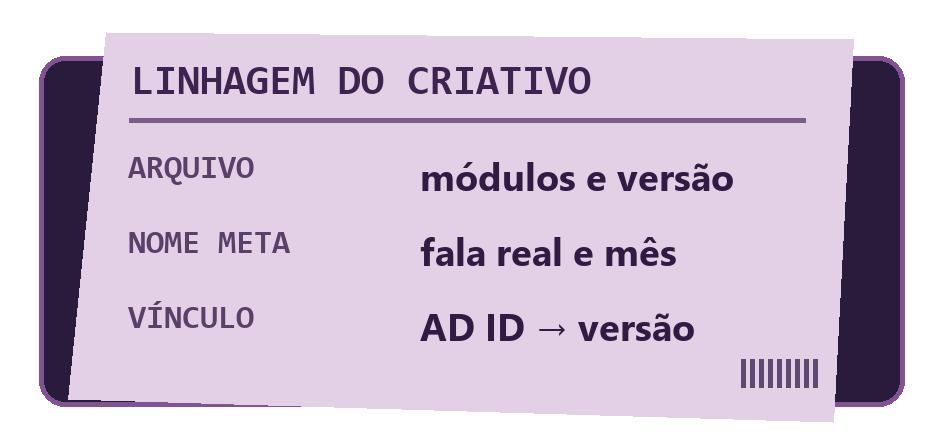
Ficha de criação com módulo, versão, nome no Gerenciador e identificação do anúncio
*The name records the version. Ad ID connects the version to the ad you served.*
Before creating or spending, a person reviews the files, the proofs, the promise, the URL, the button action, the parameters of first-party data collection and the conversion configuration. She approves or returns the review, with date. After creating the ad in Meta, check out the ad ID (AD ID) and the link with the right version. The name helps people recognize the play. The ID is the key to crossing reports and maintaining the history when the name changes. If the same piece is placed in two ads, register the two IDs linked to it criativo_id.
For example, in your lot L01, the approved file of version A receives the internal ID L01-A-v1. After creation, you register the AD ID reported by Meta in the Ads tab in the same line as that internal ID. When the query returns this AD ID, follow the link to the chart and open exactly the video that ran. With the same ID captured in the form or in the CRM, you can also recover the count of leads qualified assignable to that advertisement on its basis.
4. Extract the ad data with Stract
For the first batch, you can already export the Ads Manager report. If you do this reading every week, Stract offers the connector Facebook Ads to bring the report to Google Sheets. Use a query for the ad level and preserve the source tab. Stract Facebook Ads Connector
Facebook Ads · Google Sheets
Strat for Facebook Ads
Bring the Meta data to a spreadsheet that connects the ad ID to the creative version.
- Consultation in the selected ad account
- IDs, spend, impressions and clicks on the same cutout
- Export to a Google Sheets tab
Assemble your reading by ad
Use the Facebook Ads connector to power the raw data tab.
Hire the Strat(opens in a new tab)Affiliate link. I may earn a commission if you subscribe through this link.
- Install the Stract add-on in Google Sheets, open the sidebar, and select Facebook Ads. Connect the ad account you are allowed to consult. Installation of the Stract
- Select the ad level. Use account IDs, campaign, set, and ad, even if you also pull your names. Include spending, impressions, clicks on the link, and counting the event chosen for the test. Add the video fields you have already set, when available. Use a short period in the first test and record currency, spindle, and report assignment. Facebook Ads Fields · Documentation of the Meta Ads Insights
- Extract to a tab
Bruto_Meta. Check if two AD IDs and their numbers hit with the Manager with the same filters and cut out. Some filters and limits of the extraction can omit ads without expense or impressions. If lines are missing, check the filters and preserve the field as pending until you clarify. Reduce the period and the number of fields if the query fails. If you need to move to the set level, use this data only for diagnosis of the set. Facebook Ads extraction limits on Stract - Copy the reading as values for Readings and call by the
ad_id. For quality of the lead, bring aggregate counts of your CRM with the same ID when it has been captured at the origin. Use one row per source or keep explicit source fields. Where the ID is missing, record the coverage gaps and preserve contacts without assignment.
5. Compare cost, attention and quality in the same cutout
Metric | Formula | What you answer |
|---|---|---|
CPM |
| How much did a thousand impressions cost. Helps to understand the cost of distribution. |
Link CTR |
| How many impressions turned clicks on the link. Use the same click-through setting in both ads. |
CPA of the event |
| How much did the registration cost, the purchase or other action defined as a result in the test. For registration, this value is the CPL. |
Retention between milestones, in video |
| Proportion between reproductions that reached halfway through the video and reproductions that reached 25%. Compare videos of similar duration with the same source. |
Qualification of leads |
| Parcel of the leads evaluated with the combined profile. Show also how many you have evaluated in relation to leads tracked. |
Cost per lead qualified |
| How much was invested in relation to the leads qualified linked. Use the coherent cutout and inform the coverage of the CRM. |
Leave the fee empty when the denominator is missing or it is zero. Read totals grouped by your numerators and denominators, such as total expenditure divided by total results. Compare same offer, event, currency, assignment and delivery cutout. If Meta assigns conversion to a seven-day window after clicking on your report, a data collected the next day can still change. Record the cut and repeat the consultation after the agreed deadline. For the CRM, define also when a lead you have had time to be evaluated. Attribution windows in the Meta documentation
Set the rule before you see the result
In this example of media diagnosis, the plan is to read seven full days of delivery after the report assignment window and the review of the leads. The objective is Cost per lead qualified from up to R$ 80, with at least 10 registrations in the Meta and 10 leads evaluated by variant, in addition to coverage of the CRM enough to explain the reading. These are numbers to rehearse the method. Use the history, cost that the operation supports, and the volume of your event to set your limits. With few actions, keep the decision pending even if an ad has high CTR. If the approved spend limit arrives before the sample, follow the agreed plan and record the test as insufficient.
The numbers below illustrate two versions with the same delivery cost, the same window and, to simplify the example, all registrations located and evaluated in the CRM.
Variant | Spending | Impressions | Link clicks | Registrations Meta and evaluated | Qualified | Link CTR | CPL | Cost per qualified |
|---|---|---|---|---|---|---|---|---|
A | R$ 600 | 20.000 | 300 | 20 | 6 | 1,50% | R$ 30 | R$ 100 |
B | R$ 600 | 20.000 | 220 | 15 | 10 | 1,10% | R$ 40 | R$ 60 |
The CPM was from R$ 30 in both. A brought more clicks and registrations, while B reached the cost goal per lead qualified. For the next batch, use B as a reference and test a more specific opening with the same demo. Keep the six qualifications of A and ten of B with the recommendation. The sample shows a direction to repeat the test with another batch and look at the quality again. If the data of the CRM be late or incomplete, leave this decision under review. Meta’s assigned conversion report and the basis of leads of the company have their own measurement rules. Compare the coverage and explain the difference when the totals diverge.
Copiable prompt to plan and read the next batch
The same text works with the initial briefing and with a lot that has already returned from Meta. Fill in the parties in brackets and use only aggregated counts or data without personal identification.
Atue como estrategista e redator de criativos para Meta Ads. Quero duas variantes que eu consiga revisar e uma decisão para o lote seguinte apoiada em dados. Escreva em português do Brasil. Trabalhe em modo de planejamento e revisão humana.

Produto, oferta, público, dor e objeções: [preencha]
Provas autorizadas e afirmações que precisam de comprovação: [preencha]
Formato, destino, nome do evento e CTA: [preencha]
Controle, variável que quero testar e mês/ano do lote: [preencha]
Objetivo de negócio, meta de custo, limite de gasto e mínimo de resultados por versão: [preencha]
Janela de entrega, fuso, moeda, regra de atribuição e prazo de revisão do CRM: [preencha]
Histórico ou resultados por AD ID, com fonte e corte: [cole gasto, impressões, cliques de link, evento e volume, marcos de vídeo e, se aplicável, leads rastreados, avaliados e qualificados]

1. Liste os dados disponíveis e os campos que faltam. Preserve os AD IDs como texto. Marque valores ausentes como vazios. Só use zero quando estiver explícito na origem. Aponte diferenças de fonte, evento, prazo, entrega, moeda, atribuição e cobertura do CRM antes de comparar.
2. Com dados comparáveis, calcule CPM, CTR de link, CPA do evento e, quando houver base, retenção entre os mesmos marcos de vídeo, taxa de qualificação e custo por lead qualificado. Exiba os numeradores e denominadores usados. Se faltar maturação, amostra ou rastreamento, classifique a leitura como insuficiente e diga o que coletar. Separe dados observados de hipóteses criativas.
3. Proponha três ângulos sustentados por provas existentes. Escolha um e escreva o controle A e a variante B com uma mudança clara. Para estático, escreva a frase exata da arte e a composição. Para vídeo, escreva a abertura falada, corpo e CTA, com uma orientação de gravação. Identifique o que deve ficar igual e indique qual dado motivou a hipótese.
4. Proponha o nome técnico com ad_<produto>_<headline_real_da_arte>_<mes>_<ano> para estático e adv_<produto>_<abertura_falada_real>_<mes>_<ano> para vídeo. Use minúsculas, retire acentos e pontuação, separe palavras com underscores e confirme a frase literal e o mês/ano documentado antes de marcar o nome final. Mantenha os campos de landing page e versão da mídia separados. Deixe o AD ID vazio até existir recibo.
5. Devolva linhas para Briefings, Criativos, Anúncios e Leituras. Inclua a variável, os controles, a métrica principal, a janela e a regra de amostra. Termine com o próximo lote de duas variantes e uma lista curta dos pontos a revisar antes de publicar ou gastar. Qualquer criação de campanha, mudança de verba, publicação, pausa ou escala exige minha revisão e autorização.
Start with an offer, two pieces and a business criterion. If you come back from the round knowing what detail is worth testing again and where this conclusion came from, the next creation session already begins with a better question.