

Bots in the Stape: how to protect collection with Cloudflare without blocking the site
See how to identify automated traffic on the server-side collector, create restricted filters in Cloudflare, and check if pages, events, and SEO continue to work.

When a bot hits the collection endpoint, it can increase the technical volume without representing a person, a lead or a sale. The most common mistake is to look at just the total number of requests and block everything. The safest way begins by separating the public site from the server-side collector and understanding what each call does.
In our structure, pages and collection pass through Cloudflare, but follow different destinations. In an October audit of 2026, Cloudflare estimated about 1,17 million requests in seven days to the collector's subdomain. On the public host, another window recorded about 748 A thousand requests between 22 and 28 from October. They are different cutouts: we do not add these numbers, we do not call them visitors and we do not treat them as billable consumption of the Stape.
First-party data collection is to collect and store data in the database itself. Conversion tracking is to collect and inform data to traffic platforms. An edge rule can affect both paths, so it needs to be drawn and tested with this context.
Where the traffic is divided
Imagine two routes: visitor or robot → Cloudflare → public page and browser, bot or integration → Cloudflare → collector → Stape/GTM server-side. The same domain of protection is at the entrance, but the destination and purpose of the calls are different. A filter in the technical path of the collector does not equate to blocking the reading of an article. A broad rule in the entire domain can impair navigation, indexing, and legitimate integrations.
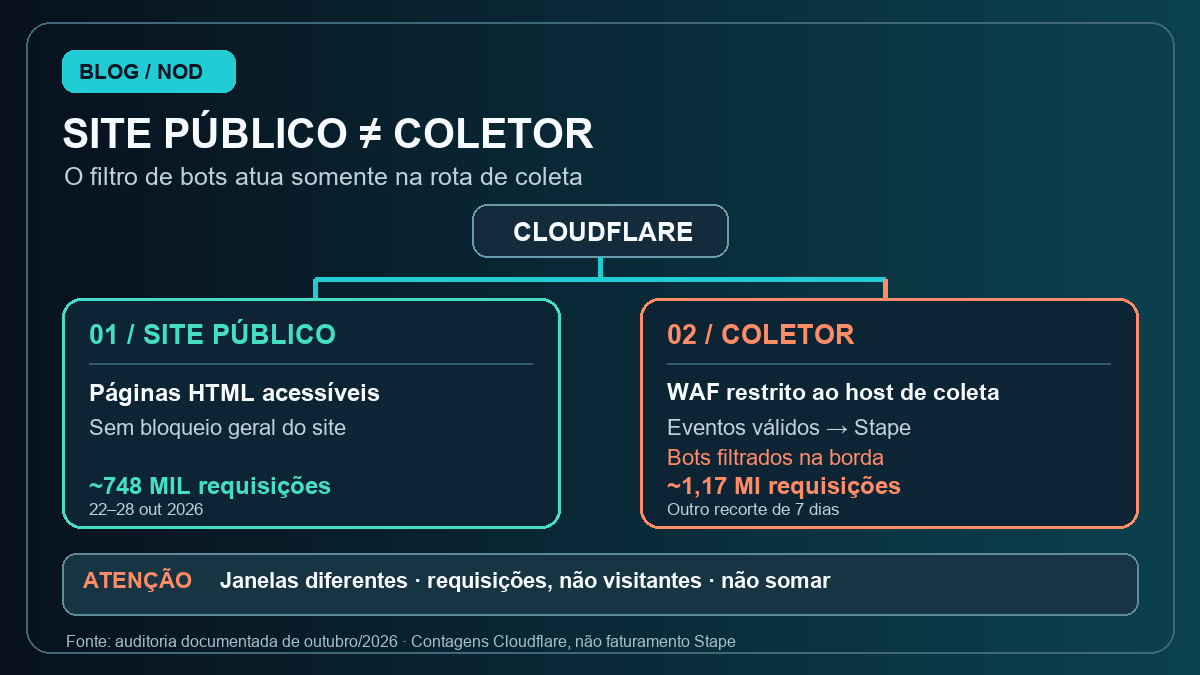
Diagrama separa site público e coletor atrás da Cloudflare: o filtro WAF atua só no host de coleta, preservando páginas HTML e encaminhando eventos válidos à Stape. As contagens de 748 mil e 1,17 milhão são requisições em períodos distintos, não visitantes.
This is the principle of the case: observe host, path, method, time and response before deciding. The text of the User Agent It is not enough alone, because it can be falsified. A Cloudflare alert that broad WAF rules can target known bots and affect SEO.
What the numbers really showed
The high volume in the collector indicated where to investigate, not who the visitor was. Calls declared as a crawler showed automated traffic in part of the clipping, but did not authenticate each identifier. Events blocked by Cloudflare proved that the rule intercepted corresponding calls; did not prove savings on the invoice of the Stape. HTTP responses 200 in the tested pages showed that these pages worked at that time; they did not prove universal availability.
There is also an operational difference: blocking a call after that she has reached the collection infrastructure is not the same as preventing her arrival at the edge. A Stape document bot detection options and advises to observe logs and possible effects in webhooks. To talk about franchise or cost, it is necessary to reconcile the same period of collection with the measured consumption.
How to Investigate Before Creating a Rule
1. Separate the collector's website
List the hosts and paths that receive HTML, files, events, and webhooks. A peak of pages may have a different origin than a peak in the technical endpoint. In our case, WordPress availability issues were analyzed separately: we did not attribute a drop to the Stape without evidence.
2. Compare equivalent periods
Write down the window, the spindle, and the meaning of each number. A series of 24 cloudflare hours and the monthly cycle of the Stape they don't measure the same thing. Record separately total requests, blocked calls, source response, accepted events, and plan consumption.
3. Map legitimate uses
Find out who uses each route: browser, GTM, webhooks, applications, previews and integrations. The documentation of the Stape remember that certain forms of blocking can hit webhooks in standard paths. If a legitimate integration uses the endpoint, it needs to enter the test before the rule.
4. Restrict the scope
In our mitigation, the filter was applied only to calls observed in the collector. HTML pages and essential features were outside the rule. A later test confirmed a real lock on a technical endpoint and responses 200 on the verified pages. It is evidence of that cutout, not promise of universal protection.
5. Test end-to-end conversion
Open the pages as a visitor, generate identified test events, check collector logs, pertinent webhooks, and destination on the platforms. A visually perfect page can hide a flaw in the arrival of the event. Also document the reversal of the rule to act fast if false positive arises.
What about Googlebot?
The name “Googlebot” written in the User Agent It does not resolve the classification. Cloudflare offers signals for verified bots, but the decision needs to consider the way. Search robots should be able to access indexable content and its necessary resources. This does not mean that they need to generate fictitious conversions in measurement endpoints. The goal is to protect the collection without creating a barrier to SEO.
This reduced the account of Stape?
The billed economy has not yet been proven. We observe blockages at the edge and follow later readings, but consumption depends on the correct cycle, legitimate traffic and other sources. In the last documented verification, the account remained in the current plan. Turning a short sample drop into “we save X per month” would be misleading.
The helpful question is: how much unnecessary traffic has stopped reaching collection without losing legitimate events? The answer requires crossing equivalent periods of Cloudflare, of the logs of the Stape and the destinations of conversion.
Checklist for your structure
- Separate reports from the public website and the collection host.
- Identify the paths that receive calls and who depends on them.
- Sort each metric by source, range, and meaning.
- Prefer specific host and path rules.
- Confirm HTML pages and search bots after you change the border.
- Test real events and integrations with identified test data.
- Compare consumption with the same period of the billing cycle.
- Record how to reverse the rule if false positives appear.
Frequently Asked Questions
Should every bot be locked in Cloudflare?
No. No. Search robots, previews, monitoring and integrations can have legitimate functions. The decision depends on the fate of the call and the effect it produces.
Can Blocking Bots Prevent My Pages from Appearing on Google?
Yes, if the rule reaches indexable pages or resources needed. A filter restricted to the collector reduces this risk, but public URLs need to be tested.
The Bot Detection of Stape solves alone?
It is a useful classification and blocking tool, but it does not replace analysis of paths, webhooks and volume that arrives before the Stape.
One 403 in the Stape does it mean economics?
Not necessarily. It shows blockage at that point in the flow. Economics requires comparing billable consumption in the correct cycle.
What is the first indicator to look at?
Start with requests by host and path. Then cross time, response, declared source and collector logs.