

Platformify: You Are Paying to Lose Control of Your Data
Plataformify is the total outsourcing of data intelligence to tools you don’t control. Understand the risks and how to assemble your own stack with GTM, database and dashboards under your control.

Do you know where your data is now?
You sign a platform of first-party data collection, paste a script on the site, set up half a dozen events and think it's tracking. But let me ask you a nuisance question: Do you know where your data is now?
I’m not talking about “in the cloud.” I'm really talking. Which server? Which country? Who else has access? Is it in the LGPD? What if tomorrow this company closes — what happens to everything you’ve collected in the last 12 months?
If you can’t answer any of these questions, congratulations: you were Platformified.
What is Plataformify
Platformify is the name I give to a phenomenon that has become an epidemic in digital marketing: a Complete outsourcing of data intelligence for platforms you don't control, don't understand and don't own.
This is when the professional — traffic manager, analyst, strategist — delivers the most valuable asset of the operation (the data) into the hands of a third-party tool in exchange for convenience. A cute dashboard, a setup of 5 minutes, a promise of "first-party data collection complete" without needing to understand how nothing works underneath.
The problem? Convenience is priced. And that price is the control.
This connects directly with what I advocate in the concept of first-party data collection vs. conversion tracking: if you do not separate data collection (first-party data collection) from sending events to platforms (conversion tracking), you get held hostage by those who do both for you.
The 4 risks that no one wants to see
1. Your data is not yours
When you use a platform of first-party data collection outsourced, the data goes through its servers before it gets anywhere. Do you trust that they are treating this with the seriousness they should? Have you read the terms of use? Do you know if they use your data to train models, sell aggregate insights, or feed other products?
Most of the time, the answer is no. You’re blind — and paying tuition for it.
2. Compliance is your problem, not the platform
The LGPD does not accept "I didn't know" as a defense. If the platform you use collects data irregularly, sends information to servers outside the country without legal basis, or stores sensitive data without proper consent, The responsibility is yours. You are the data controller. The platform is just the operator — and the contract between you probably protects it much more than you do.
You are entrusting the legal compliance of your operation to a company you don’t even know where it is.
3. Platforms break, pivot and close
The martech market is a tool graveyard. Platforms that were "the future of tracking" two years ago today don't even exist anymore. Others change the business model, increase the price 300% from one hour to the next, or simply degrade the product because the investment has dried up.
And when that happens, what's left for you? Nothing. Zero. Your historical data, your integrations, your entire measurement structure—all disappear. Because you He built his house on the neighbor’s land.
4. You don't learn anything
Maybe that's the worst of all. When a platform solves everything for you with "one click", you do not develop the technical competence to understand first-party data collection really. You don't know what a server-side request is, you don't understand how an event is fired, you can't debug when something breaks.
You become dependent. E professional dependent on tool has expiration date.
That is exactly why in the N8N, for example, I teach you how to assemble workflows from scratch — not import ready-made templates. Because the value is not in the workflow running, it is in you to know why it runs.
"Don't build your house in the neighbor's grounds"
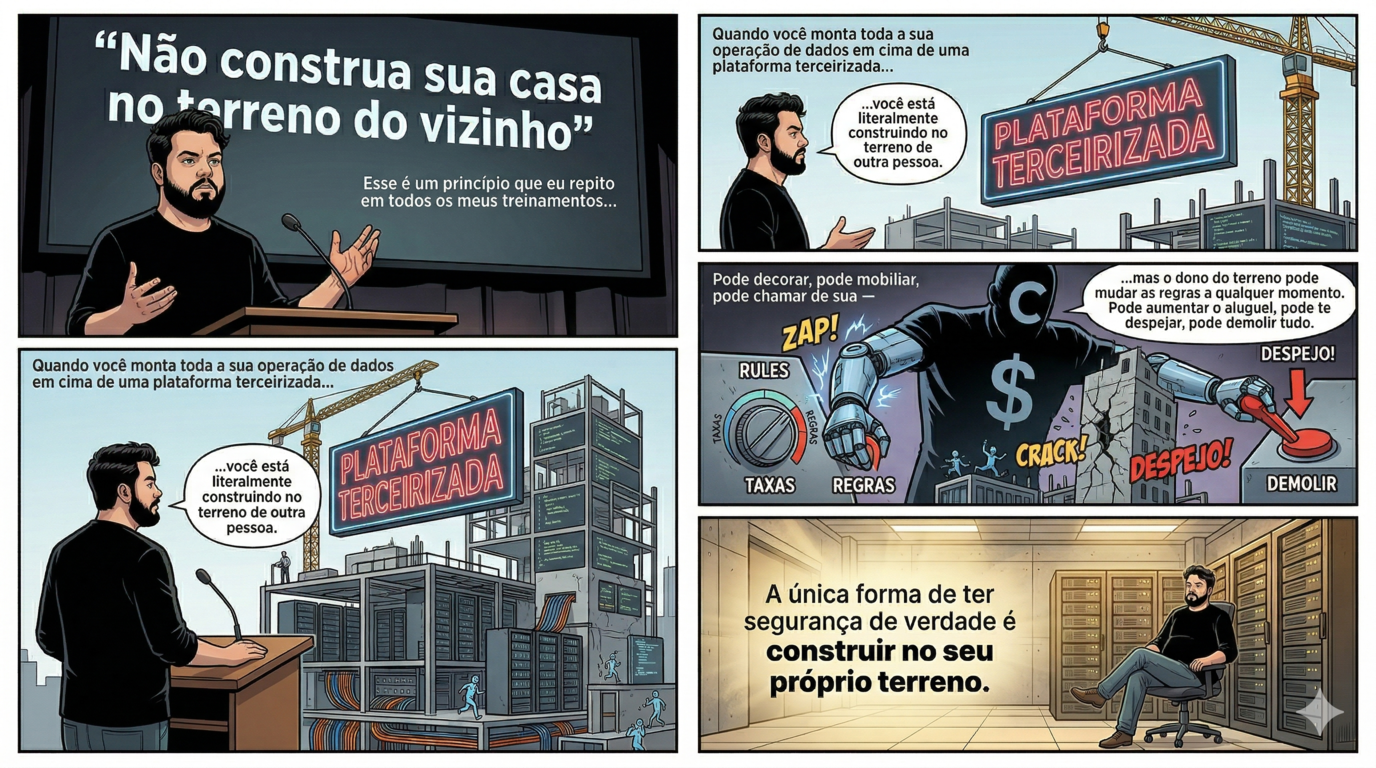
HQ - Não construa sua casa no terreno do vizinho
That is a principle that I repeat in all my trainings. And it applies perfectly here.
When you mount your entire data operation on top of a third-party platform, you’re literally building on someone else’s ground. You can decorate, you can furnish, you can call your own – but the owner of the land can change the rules at any time. It can increase the rent, it can dump you, it can demolish everything.
The only way to have real security is build on your own ground.
The alternative: your stack, your rules
The good news is that setting up an infrastructure of first-party data collection it's not science fiction. It’s simpler than they sell you — and infinitely more powerful than any shelf platform.
The stack I stand for and teach is based on three pillars:
GTM (Google Tag Manager) and N8n The brains of the operation. It’s where you set up, control, and fire all your events. Both on the client-side and the server-side. It is free, flexible, documented and with a giant community. You have complete control over what is collected and where it is sent.
Own database Your data is on your server. It can be a simple SQL bank, a PostGres, MySQL, BigQuery — which makes sense for its size. The point is: the data is yours, it's under your control, and no one can take that away from you. If a tool changes, you change it. Your data is still there.
Dashboards under your control — Data Studio, Metabase, whatever. The visualization layer connects directly to your bank. No intermediaries, no artificial limitations, no extra pay to see your own data.
This triad gives you something that no third-party platform can offer: sovereignty over their data.
And when you add automation with N8N in this stack, you get the processing layer: webhooks, integrations with CRM, firing of server-side events to Meta CAPI and Google Ads — everything going through your server, under your rules.
"But it's more laborious..."
Yeah. Yeah. Yeah. So what?
Building a real house is also more laborious than renting a furnished apartment. But it's your house. No one dumps you. No one increases their rent. No one decides that you can no longer use the kitchen.
The "work" of mounting your own stack is, in reality, investment in competence. Every hour you spend setting up one GTM server-side, structuring a bank, or setting up a dashboard, it’s an hour that makes you a more complete, more independent and more valuable professional to market.
Meanwhile, those who are "saving time" with a third-party platform are building a career on top of quicksand.
The invitation
If you recognized yourself at some point in this text, don’t blame yourself. The entire market was pushed in that direction—by aggressive marketing, by collective laziness, and by a culture that values speed above solidity.
But now you know. And knowing changes responsibility.
Start small. Choose a project, assemble the stack itself, learn the process. It'll hurt at first. It's gonna take longer. But when everything is running — on your server, with your data, under your control — you’ll understand why I hit that key so much.
Stop being platformified. Build on your ground.
If this concept makes sense to you, share this article with that colleague who is paying R$500/month on a platform and doesn't even know where his data sleeps.