
Meta’s Andromeda: What has changed in ad selection and how to review your creatives
Understand what Andromeda is at Meta, how the ad selection has changed in 2026 and use a practical checklist to review creatives without promises of result.

Direct response: Andromeda is the step you choose, among many eligible ads, which follow for later delivery analysis. In 28 october of 2026, Meta presented an architecture that evaluates more candidates with a more expressive model, within the latency budget of the platform. This does not create a new button in the Ads Manager or determine, alone, which ad will appear. For the advertiser, the job remains to offer relevant messages, measure real results, and review the path after the click.
“Reading in 30 seconds
- What is: initial selection of ad candidates, before the ranking.
- What has changed: model, processing and hardware went on to work together to evaluate a larger set of ads in more detail.
- What to do: test really different situations and messages, keep offer and destination coherent and measure customers and cost, plus clicks.
- What not to conclude: “The targeting is over,” “everyone needs dozens of ads,” or “the algorithm now guarantees more sales.”
If you advertise on Facebook or Instagram, probably saw someone say that “Andromeda changed everything.” That phrase doesn’t help decide the next creative. The useful question is: at what point in the delivery does it act, what has the update effectively changed and what can you test on your account?
First: what happens before an ad appears?
Imagine that a person opens the Instagram. There is a large universe of potentially eligible ads. The platform cannot apply the heaviest analysis to all of them in the time available to respond to that opening. Therefore, the recommendation of advertisements occurs in stages. A Recovery of candidates (retrieval) reduces the initial universe to a smaller set; later steps, including the ranking, make more detailed assessments before the display. A Meta describes this sequence in the original presentation of the Andromeda, in 2024.
Andromeda is active in recovery. Your ad needs to be eligible and enter the candidate set to be able to move forward. This does not mean that Andromeda is the entire auction, that you choose the winner alone, or that a campaign has an “Andromeda score” visible to the advertiser.
Didactic diagram, created for this article. It does not represent an internal screen or reproduce the implementation of the Meta.
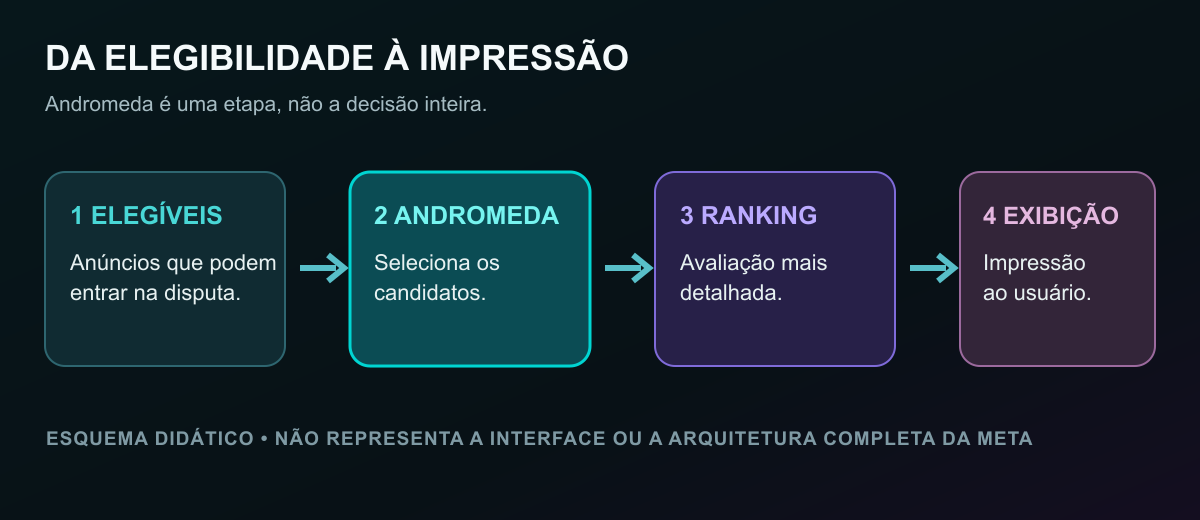
Fluxo didático: anúncios elegíveis passam pela seleção de candidatos do Andromeda antes do ranking e da impressão.
An analogy: in a library, you first find the books that can answer your question; then read the candidates more carefully. If a promising book does not enter the first selection, the detailed analysis does not reach it. The analogy explains the order of the steps, not a literal rule of delivery.
What Meta announced in October 2026?
The Technical article published by Engineering at Meta in 28/10/2026 It describes a new generation of the system. The problem is clear: automatic and AI tools have greatly increased the volume of candidate ads, while the response to each request continues to be fast.
The solution presented joins three layers:
- Model: An architecture inspired by mix of experts relates signs of the person, the context and the advertisement. Different experts can contribute according to the interaction analyzed.
- System: operations that previously required more data transit were gathered in a more integrated processing flow, including matching targeting rules, scoring and choosing the best candidates.
- Hardware: the design leverages the GPU to reduce data movements and keep latency under control.
It's an infrastructure change within the Meta. You don’t have to activate “Andromeda 2026“in the campaign. There is also no basis in the article to say that public rules no longer exist: the technical description itself includes the verification of the segmentation rules defined by the advertiser.
How to read the numbers without turning benchmark into promise
The text of the Meta informs that the production system evaluates more than a billion ads per second in the complete recovery pipeline. It also reports more than Ten billion per second for a score component measured in isolation on a GH200 GPU. They are measures of different parts and conditions; they are not “prints per second”, nor the number of ads that a person sees. The reduction of approximately 300 times in inference FLOPs compares the new recovery architecture to the version of 2024, does not mean “300 times more sales.”
The Goal has been attributing to Andromeda since 2025, an aggregate increase of 2,4% in conversions on Facebook. This is a result reported by the platform for the analyzed set, not a forecast for your account. The article does not provide a multiplier that you can apply to the budget of the next campaign.
Segmentation is still in the process
A common interpretation is that if AI selects candidates, setting up public doesn't matter anymore. The technical article says something more specific: the new stream includes the step that verifies the segmentation rules defined by the advertiser. This correspondence was taken for the processing on the GPU along with the score and the selection of the candidates. Therefore, the architecture of the stage has changed; the existence of eligibility rules has not disappeared.
This does not solve, in itself, the question about what breadth of audience to choose in a concrete campaign. A restricted audience can reduce the number of eligible people; a broad audience requires that supply, message, and measurement be clear to evaluate the outcome. The choice depends on the purpose and testing of the operation. Do not use a news story about infrastructure as a universal order to erase segmentations or bring all audiences together.
Four misreadings worth separating:
- “Andromeda chooses the winning ad alone.” He recovers candidates; the ranking and other stages continue afterwards.
- “It’s ten billion impressions per second.” The number refers to the punctuation flow of an isolated component, not impressions.
- “The segmentation is over.” The update also processes the advertiser’s targeting rules.
- “My campaign will sell 2,4% more.” The Meta reported an aggregate result, which does not provide for an individual result.
What does this change for those who create ads?
The technical source explains the platform’s ability. The following recommendation is my editorial interpretation: if the system can relate more advertisements and contexts, it makes sense to deliver pieces that represent problems, desires and different situations. This extends the chances you can test. There is no mandatory number of pieces at the source, a winning format, nor a guarantee that creative variation improves the campaign.
Think of an English course. You can publish three videos with the phrase “learn English” and change only color, track and transition. There are three presentations of the same message. This may serve to test visual execution, but it does not respond to which audience situation is strongest.
Another hypothesis would be to create:
- Interview: “Do you understand the question in English, but it crashes in the answer?” The demonstration shows an interview situation that the course actually covers.
- Travel: “Can you ask for help without relying on the translator?” The piece presents a concrete application, provided that the offer delivers this learning.
- Working meeting: “Do you need to explain an English idea to the team?” The opening and landing page maintains that expectation.
Now there are three Messages to compare, in addition to formats. None is “approved by the Andromeda” by definition; they are hypotheses of communication. The test needs to consider budget, objective, volume of data and what has changed between versions.
A simple test to learn from differences
Before creating the pieces, write the hypothesis of each: “the interview situation generates leads more qualified,” for example. Keep the goal, supply and conversion path comparable. Identify each ad with a name that allows you to retrieve the message and version. Then record the results observed in the same period: range, clicks, leads valid, customers and cost, depending on the available volume.
If the interview video uses a specific page and the travel page uses a generic page, you have changed message and destination. It can be a valid test of the complete journey, but do not attribute the difference only to the theme of the video. And if few customers come, treat the result as a still weak signal: there is no magic volume in the Meta ad that turns a small sample into a definitive conclusion.
In the end, choose the next question. A message attracted attention, but didn't it bring customers? Review the promise and destiny. Other brought fewer clicks and more suitable customers? Investigate the cost and quality before you discard it. The purpose of the test is to learn about its operation, not to look for an invisible seal of algorithm approval.
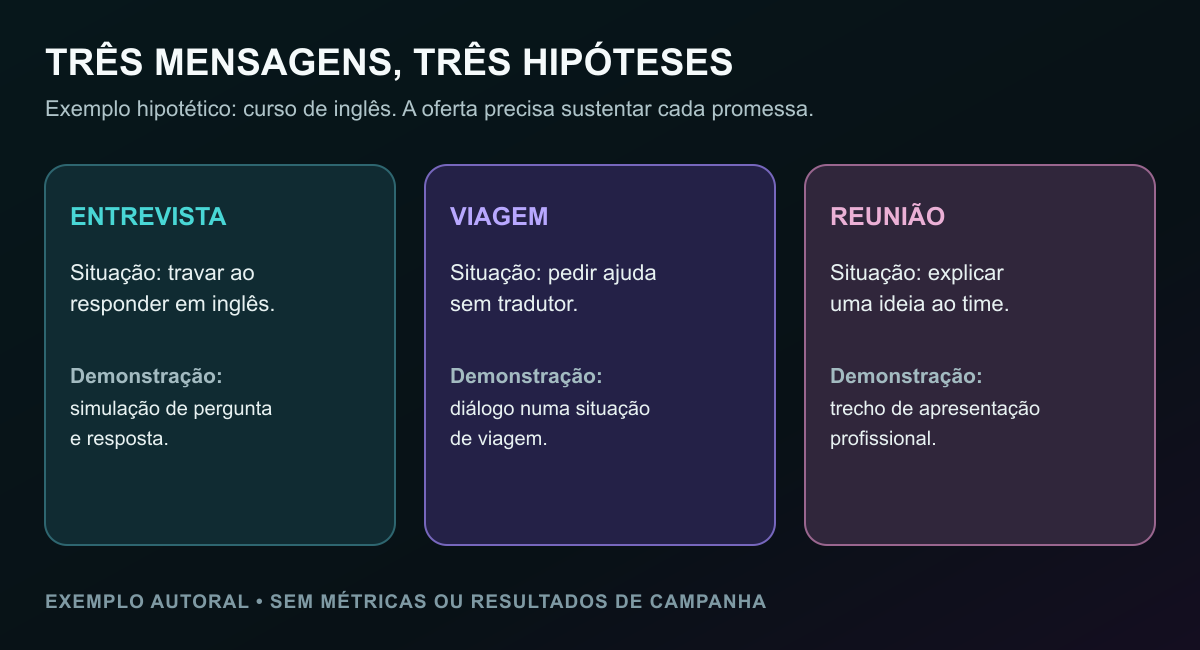
Matriz didática de três mensagens para um curso de inglês: entrevista, viagem e reunião, cada uma com situação, promessa e demonstração.
Hypothetical example. It does not represent results of a real campaign.
The creative does not end in the click
If openness speaks of interview and fate opens a generic page without mentioning this situation, you have created a break of expectation. If the offer promises a skill that is not taught, the problem is not the algorithm. If the ad gets attention but the form fails, looking only at CTR can hide the loss.
It is worth following the indicators compatible with the objective: people who have reached the page, leads valid, customers, cost per customer and quality of service. A number of isolated clicks do not say whether the campaign generated business. Compare periods and versions carefully; an observed difference does not prove that Andromeda caused it.
To separate the reading of the platform from its own base, see also the Guide of conversion tracking in paid traffic. If you use AI to produce images of the ads, the process of visual identity and human review is in the article about Creatives with AI. They are complementary subjects: the update of the Andromeda does not validate the quality of the events sent or correct a confusing visual piece.
Checklist: review your next creatives
Use the questions below before putting a new variation in the air. It's one Authorial work checklist, not a list published by Meta.
- What situation are you showing? Write a concrete problem of the public. Example: in an interview in English.
- Does the message really change? Compare the pieces without color, track and transitions. If they all say the same thing, you’re testing presentation; this may also be helpful, but you answer another question.
- Does the opening match the offer? If you start by talking about interview, show how the solution helps in this situation. Don’t promise a benefit that she doesn’t deliver.
- Does the demonstration hold the promise? Use real examples, verifiable explanation, or true screen. Do not invent testimony, gain or ease.
- Can you compare the tests? Record hypothesis, message, format, audience, destination and what has changed. If everything changes at the same time, the causal reading becomes weak.
- What is the business outcome? Separate attention and clicks from customers and cost. Choose indicators that are compatible with the objective and volume available.
- Does destiny work? Open the page, form or conversation and go the whole way, including on mobile. Click without continuity does not demonstrate ad quality.
A simple fact sheet already helps: hypothesis → situation shown → piece → destination → main indicator → observed result → next decision. Also save the creative version so you don’t assign to a new sentence the effect of an amended offer or page along.
Frequently Asked Questions
What is Andromeda in Meta ads?
It's Meta's ad recovery system. He selects eligible candidates so that later steps, such as ranking, make a more detailed assessment before the screening.
Does Andromeda replace segmentation or ranking?
No. No. The article of 2026 describes the match with advertiser segmentation rules within the stream and maintains the later ranking step. The update improves recovery, does not eliminate other decisions.
Do I need to enable a setting to use the update?
The technical publication presents a change in Meta’s infrastructure, without instructing advertisers to enable a specific control called Andromeda. Review the normal campaign settings and customer path according to your goals.
How many creatives should I test because of Andromeda?
The Goal does not determine a number in the technical article. Define the volume by budget, production capacity and possibility to analyze results. A well-documented message variation teaches more than dozens of pieces almost equal without a clear hypothesis.
The improvement of 2,4% in conversions is valid for my campaign?
It is not possible to conclude that. This is an aggregate result reported by the Meta since 2025 on Facebook, not guarantee or forecast for a specific account.
In short
Andromeda selects candidates before of the ranking. The October update of 2026 increases the capacity of this selection through the joint design of model, system and GPU. For those who advertise, the practical consequence is not to pursue an algorithm formula: it is to formulate distinct messages that the offer sustains, test with method and measure what happens to the customer.
Sources
- Meta Andromeda: Powering the Next Generation of Ads Retrieval Through Model-System Co-Design — Engineering at Meta, 28/10/2026. Main source for updating, architecture and technical numbers.
- Meta Andromeda: Supercharging Advantage+ Automation With the Next-Gen Personalized Ads Retrieval Engine — Engineering at Meta, 02/12/2024. Context of the original deployment and the stages of recovery and ranking.
Examples of the English course, the messaging matrix, and the checklist are interpretations and editorial tools of Dericson Calari. None of them are literal guidance from the Meta or given from a real campaign.