
How I set up a Black Friday with AI: pages, automations and data
Watch the Black NOD behind-the-scenes look 2026: how I organized planning, pages, creatives, automations and data reading with AI support and human review.

A Black Friday involves much more than a page with offer and some ads. At Black NOD 2026, I needed to make creatives, pages, registration, communication, campaigns and analysis talk to each other. This article opens the process I showed in the video: where artificial intelligence helped, what already existed before it and what I needed to check out in person.
It was not a prompt that made an entire operation appear ready. The gain came from using context, documentation and review to make each piece move forward without losing the reasoning of the campaign.
Watch the full backstage
The video was posted in 18 october of 2026 and has about 38 minutes. In it, I open the screens of planning, of the pages, of the n8n, from WhatsGrupos, from ad platforms and the RastrackDash Launches. Below, I organized the learnings for you to consult without having to watch everything at once.
The operation map, in a reading
Existing materials → plan and documentation → creatives and capture pages → validated registration on the basis of its own → phase communication → sales and ads page → journey reading.
That order matters. If the ad promises one thing and the page opens with another, the AI may have produced two beautiful pieces that don't work together. If the form displays a success message but does not save the registration, the operation is broken. And if the sale appears only on the media platform, I lose part of the context to decide.
How I organized the campaign
1. I started with what already existed
Before asking for anything from AI, I gathered pages, materials, products, data and decisions that were already available. This avoids rebuilding everything from scratch, and most importantly, it prevents every conversation with an AI tool from inventing a different version of the campaign.
I also separated the phases. The capture had its own pages and invitations; the sales phase required another page, other destinations and other communication. This passage was planned from the beginning. In the video, I show how I documented the turning rules, including the exchange of links and what needed to be paused or activated.
Practical Application: Before opening the chat, make a list with the offer, the audience, the approved materials, the channels, the destinations of each phase and who validates what. AI works best when it gets that context; so does the team.
2. The documentation held continuity
I used a central documentation to record versions, responsibilities, decisions and pending. Thus, when one step went from one chat or agent to another, the work did not begin again based on the incomplete memory of a conversation.
At Google Docs, I organized the creatives by audience, angle and format. For communication, I documented day, time, goal, content and media. There’s a big difference between having a list of ideas and having a plan that someone can review and execute. The documentation also made visible which version was in work and which had been approved.
A rule that helped me: created file does not mean published piece. The same goes for mounted page, campaign sent or automation configured. Each of these actions needs verification of its own.
3. I made an announcement and page continue the same conversation
I have prepared two capture page versions. I reviewed copy, form and reading on mobile. An important detail was the continuity between the creative and the page: the promise and angle of the ad should appear recognizably in the headline and the rest of the experience.
If a person clicks on an ad for a specific reason and finds a generic openness, the campaign loses coherence. In the video, I show you how I worked dynamic headlines to maintain this connection between origin, message and destination. This does not require testing the page on each entry path: correct headline, working form and next clear step.
Review question: looking only at the ad and the first screen of the page, can the person understand that he has reached the right place?
4. I checked the registration to the database
The capture stream went through WordPress, n8n and own bank. In the video, I show the flow structure and the care with validation and confirmation of persistence. The test did not end when the form displayed a positive warning: I needed to check if the data had been received and saved before processing the registration as completed.
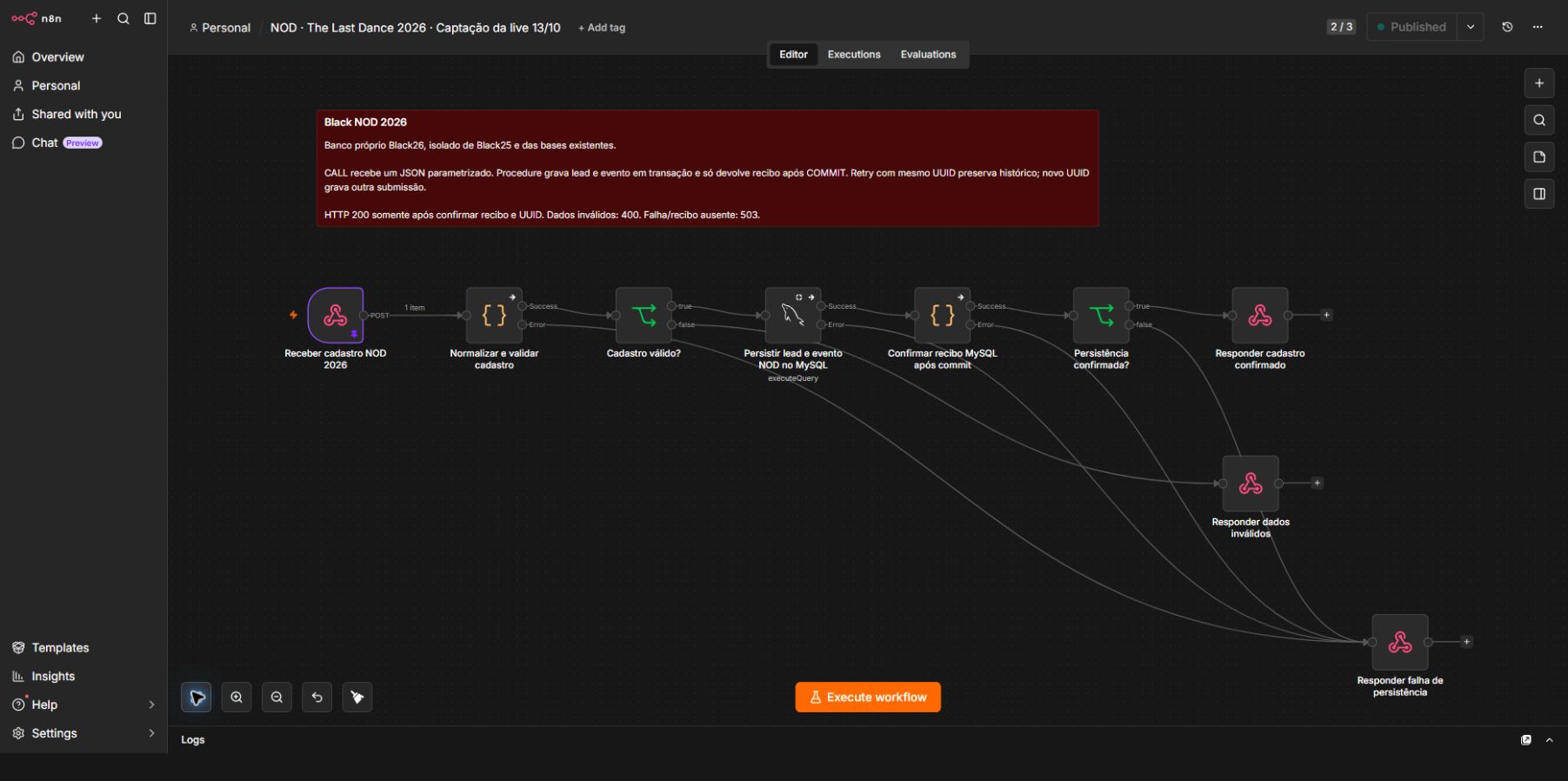
Fluxo real de cadastro da Black NOD 2026 no n8n, com etapas de recebimento, validação, persistência no banco e resposta; captura não comprova execução em produção.
Then came the invitation to the group. Open invitation is not the same thing as confirmed entry. This distinction sounds small, but it changes the reading of the funnel and prevents me from calling it an intermediate step of final conversion.
The capture diagram is part of the Black NOD production 2026. It illustrates the structure of registration and validation; the isolated image does not prove that each execution took place in production.
5. I produced creatives and communication by phase
AI helped organize scripts, variations and revisions, while I checked the idea and destination of each piece. I worked static formats for Feed and Stories and also video. The CTA needed to fit the operation of each platform: a call designed for one channel could not be automatically copied to another.
In group communication, WhatsGrupos helped me separate capture, heating and sales, with content, destination, scheduling and status. This reduces the chance of a wrong phase message coming out at the wrong time and makes it easy to review what was planned, scheduled, or actually sent.
Example of organization: for each message, register public, phase, objective, media, destination link, time and state. The “scheduled” stage is different from “sent.”
6. I planned the turn for sales
The operation had a longer sales page for the campaign and a short version for the hottest live audience. There was also a sequence of changes to be performed when the capture phase ended: pages, URLs, link in the bio, blog banner, campaigns and messages.
The point here is to know which piece changes, when it changes and how to confirm that the right version is in the air. Campaign submitted is not campaign in broadcast; open page does not prove checkout and delivery. This check was part of the work, not a later detail.
No Meta Ads and in the Google Ads, I documented nomenclatures and links to make it easier to read the operation. This helped connect what appeared in the ads with the pages and with the data I wanted to follow afterwards.
7. I used the data to understand the journey
For me, first-party data collection is to collect and store data on its own basis. Conversion tracking is to collect and inform this data to the traffic platform. The first-party data collection leaves the person intelligent; the conversion tracking leave the platform smart. Both can complement each other, but they are not synonymous.
No RastrackDash Launches, the proposal was to read origin, page, group, registration and purchase in the same context. An assignment based only on the last click can hide relevant stages of the journey. You can also not decide for an isolated number without knowing how it was collected and what period it belongs to.
The screens and numbers featured in the video serve to explain the structure. Do not read demonstrative values as historical results of Black NOD. Replicable learning is the method: link events and decisions with the origin of the data, review the quality of the collection and separate evidence hypothesis.
What would I check before calling the operation ready
- Does the promise of the creative continue on the front screen of the page?
- Do the two page versions open and work on mobile?
- Does the form send, receive a proper response and save the registration on the basis?
- Was the invitation to the group displayed and is the effective entry measured separately?
- UTMs and source identifiers keep up with the right links?
- Are messages and creatives in the correct phase, channel and version?
- Was the turn of fundraising for sales executed in the combined destinations?
- Are ads effectively in service, with links and budget checked?
- Does the dashboard distinguish demonstrative data, actual events and collection gaps?
That list is the antidote to the false sense of “AI has already done everything.” The tool accelerates parts of the process. Responsibility for consistency, verification and decision continues with me.
Where to see each part in the video
- 01:42 — existing materials and initial context.
- 05:14 — documentation, versions and continuity.
- 07:14 — creative and communication plan on Google Docs.
- 09:21 — capture pages and dynamic headlines.
- 11:29 — WordPress, n8n, registration and own base.
- 17:54 — creatives, review and formats.
- 21:25 — organized communication on WhatsGrupos.
- 23:31 — sales pages and turn of the campaign.
- 28:36 — reading no RastrackDash Launches.
- 34:44 — full map of the operation.
The lesson that remained
The most useful use of AI in this Black was to maintain a complex intelligible operation. I took advantage of what already existed, documented the context, distributed the work and conferred the result of each step. If you want to apply this logic to your release or the upcoming Black Friday, start with the phase map and validation points. Then choose the tools.
This is a behind-the-scenes account of Black NOD 2026. Pages, offers and campaign states may change; the examples here explain the process and do not promise the same results for another operation.