

Data Infrastructure for Sales Platforms: The 6 Pillars that Every Traffic Manager Should Demand
Discover the 6 fundamental pillars that a digital selling platform needs to have to first-party data collection, conversion tracking and assignment of truth. GTM at checkout, transparent checkout, full webhook and more.

Why does your sales platform’s data infrastructure matter
The quality of the data infrastructure of a digital sales platform is one of the most determining factors for the success of paid campaigns. A platform that does not expose rich data at the time of purchase forces the traffic manager to work in the dark: not knowing who bought, where it came from, which ad converted or how to recover those who did not finish.
Each transaction that takes place on a platform must generate a comprehensive set of structured data, made available natively both via dataLayer (for GTM) how much via webhook, enabling direct integration with Meta Ads, Google Ads, other traffic platforms, platforms of CRM and BI systems.
“This documentation describes the structural advantages of platforms with good infrastructure in the context of data, first-party data collection, conversion tracking and attribution of sales.
Overview of Resources
The platform should offer at least Six fundamental pillars of data infrastructure:
- Native integration with GTM at the checkout — Rich dataLayer with real-time journey events and user data
- Transparent checkout (own domain) — Journey of the lead without domain breakage, preserving cookies and attribution
- Redirect with dynamic parameters — Transfer of UTMs and parameters to post-purchase upsell pages
- GTM installed globally (account and product level) — A single installation applies to all products, with the possibility of GTM specific by product
- Complete webhook with transactional data — Detailed payload with buyer, product, financial and UTMs data
- Support subscriptions on the webhook — Billing cycles, defaults, renewal and invoice data
1. Native integration with GTM the Checkout
Direct integration with the Google Tag Manager within the checkout itself. This means that dataLayer is already automatically populated by the platform with rich data at every step of the buyer’s journey, with no need for customized development.
Why it matters: Most platforms fire just one purchase event on the thank you page. A good platform triggers events at each stage of the checkout, with complete user data already available from the first contact with the form.
Events Triggered in DataLayer
The following events should be automatically triggered during the checkout journey:
- form_start — Opening of the checkout form. Available data: infrastructure (IP, city, user agent, cookies). It is data that it is possible to obtain without filling on the part of the user.
- addToCart — Start of completion (step 1). Additional data: product, value, currency along with data from previous events.
- begin_checkout — After filling in contact. Additional data: hashead and non-hasead email, name, phone, payment method, among others depending on the information filled in.
- purchase — Confirmation of purchase (redirect). All complete purchase data + transaction_id.
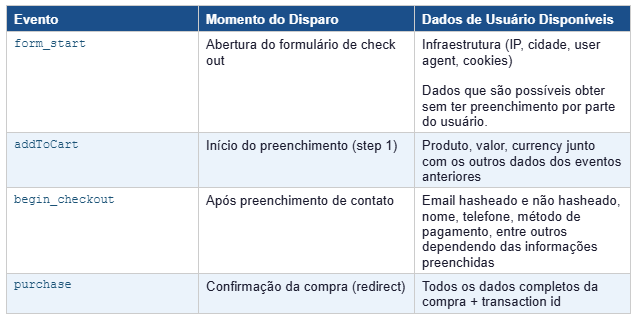
Eventos Disparados no DataLayer
Structure of DataLayer
Each event contains a standardized payload with four main blocks of data:
Click Identifiers (Crowd-platform Attribution) — Present at all events, from the first access: fbclid (Click ID of Facebook Ads), fbp (Facebook Browser ID), ga (Google Analytics client ID), gid (Google Analytics session ID), gclid (Google Click ID), plus gbraid, wbraid for Google Ads and others for TikTok Ads, Kwai, Taboola, etc.
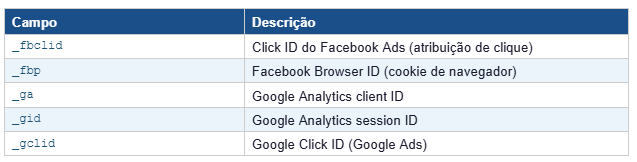
Identificadores de Clique (Atribuição Multi-plataforma)
User Contact Data — Available in two formats: hasheado (SHA-256) for conversion APIs, and nailshed for internal use. Includes email, phone, name, document (CPF/CNPJ), city, state, zip code and country.
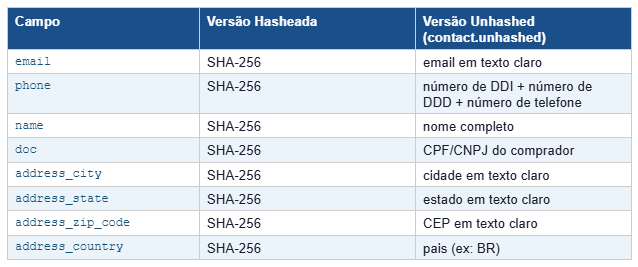
Dados de Contato do Usuário
Infrastructure Data — Geographic and technical information of the buyer’s device: IP, city, geographical coordinates, region, country and full user agent of the browser. Data obtained automatically via API geolocation by IP.
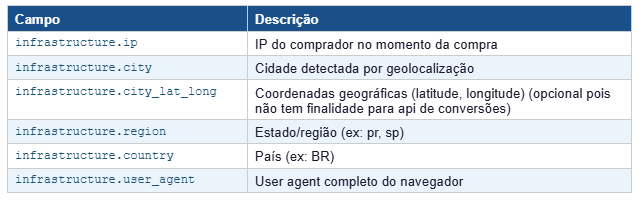
Dados de Infraestrutura
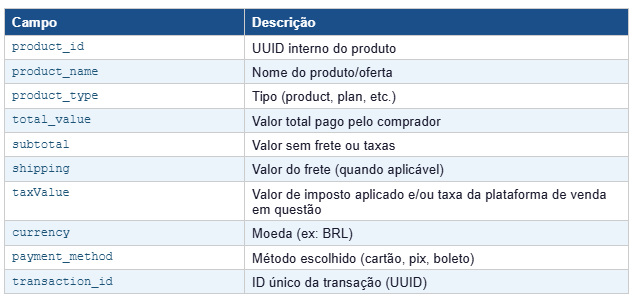
Product and Transaction Data — product_id (internal UUID), product_name, product_type, total_value, subtotal, shipping, taxValue, currency, payment_method and transaction_id (single transaction UUID).
Dados de Produto e Transação
ECommerce Enhanced compatibility (GA4 and UA)
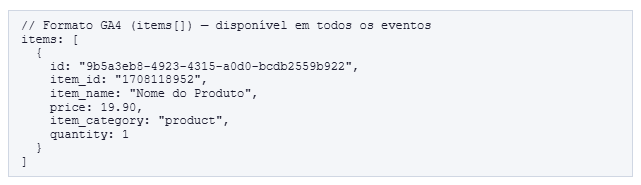
DataLayer must be compatible with Google Analytics' Enhanced eCommerce standards, including ecommerce.purchase, ecommerce.checkout and ecommerce.checkout_option, in addition to the items[] matrix of the GA4.
Matriz Items do Google Analytics 4
Purchase without Thank You Page
The platform should allow you to record and track conversions from your own checkout, eliminating the mandatory need for a thank you page. The purchase event is triggered at the time of confirmation, direct at checkout.
This increases the accuracy of the first-party data collection because it avoids losses caused by users who close the browser before arriving on the thank you page.
2. Transparent Checkout (Own Domain)
The transparent checkout allows you to integrate your own domain in the checkout. Example: checkout.seumominio.com.br.
Why the Domain Matters to the First-party data collection
- No domain break: o lead it does not leave your domain during the journey. This keeps cookies, sessions and identifiers intact
- First-party cookies: browsers such as Safari (ITP) limit third-party cookies. With checkout in your domain, cookies are first-party and have higher validity
- Best assignment: o fbclid, gclid and UTMs that arrived on the site remain available at checkout
Impact on Data Match Quality — Meta Ads
Transparent checkout directly improves the Event Match Quality (EMQ) of the Meta Ads. When the checkout is in the same domain:
- The cookie fbp (Facebook Browser ID) is first-party and persistent
- The fbclid is preserved in the URL throughout the journey
- Meta can match between ad click and conversion with greater accuracy
No transparent checkout, the lead changes the domain and the browser can block cookies — reducing match rate and impairing algorithm optimization.
3. Custom Redirection to Upsell
After purchase, the platform should allow you to redirect the buyer to an upsell page with custom URL parameters.
How It Works
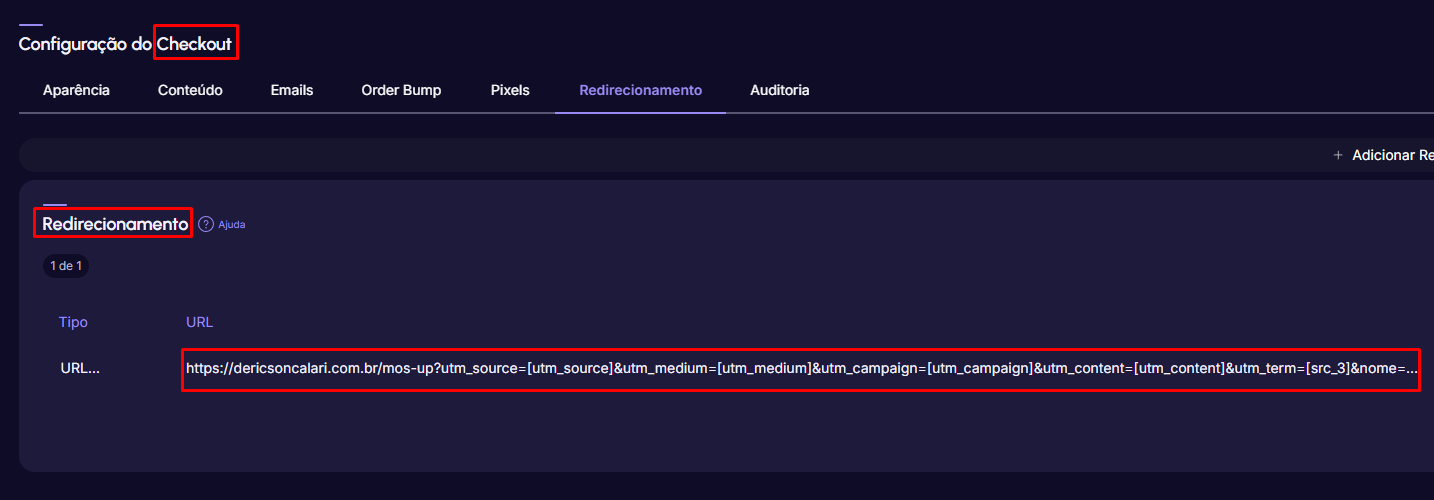
The buyer finalizes the purchase and is redirected to a configurable URL. In this URL, the platform can automatically inject dynamic parameters such as UTMs, transaction IDs, and buyer data.
Redirecionamento para página de Upsell com parâmetros de URL
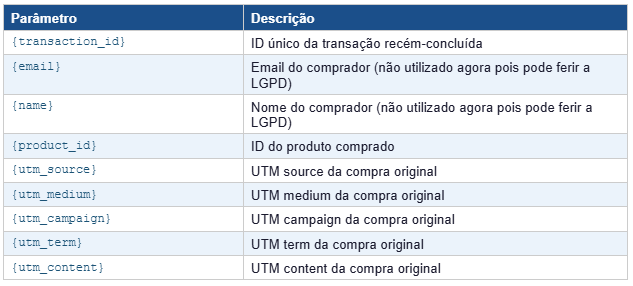
Supported Dynamic Parameters
The platform must support transfer of original UTMs, transaction_id, buyer email, and other custom parameters to the upsell page — keeping the attribution chain intact.
Without it, the purchase of the upsell would appear as "direct" on your dashboard — not knowing which original ad generated that one lead.
“The ideal is also to have a system that can manage any URL parameter that arrives in the checkout URL and has only fixed parameters that are collected.
Parâmetros Dinâmicos Suportados
4. GTM Installed at Global Account Level and Product Level
The platform should allow the installation of the GTM both globally (a single facility applies to all account products) and individual product level.
Operational Advantages
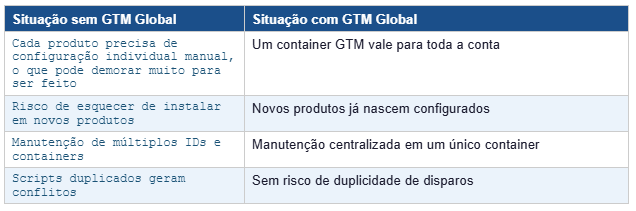
Vantagens Operacionais de se ter configuração global do GTM na plataforma de vendas
Without GTM Global: Each product needs individual manual configuration, risk of forgetting to install on new products, maintenance of multiple IDs and containers, duplicate scripts generate conflicts.
With GTM Global: a container GTM valid for the entire account, new products are already born configured, maintenance centralized in a single container, without risk of duplication of shots.
It should also be possible to configure at the product level for scenarios where you use different domains for different products. For example, one domain for training and another for SaaS tools, with separate GTMs.
For multi-product operations, this feature eliminates hours of repetitive setup and dramatically reduces the risk of human error in the implementation of first-party data collection.
5. Complete Webhook with Transactional Data
The webhook must be fired at each relevant transactional event (approved purchase, refund, signature created, default, etc.) and deliver an extremely rich JSON payload, allowing integration with any external system: CRM, spreadsheet, server of conversion tracking, BI tool or proprietary system.
“The webhook eliminates the need to rely solely on the frontend to track conversions. With a server of conversion tracking (server-side GTM, for example), it is possible to capture 100% conversions, including users with adblockers.
5.1 Buyer Data
The payload includes the complete profile of the buyer: name, email, CPF, telephone (with DDI), full address (locature, number, neighborhood, city, state, zip code, country).
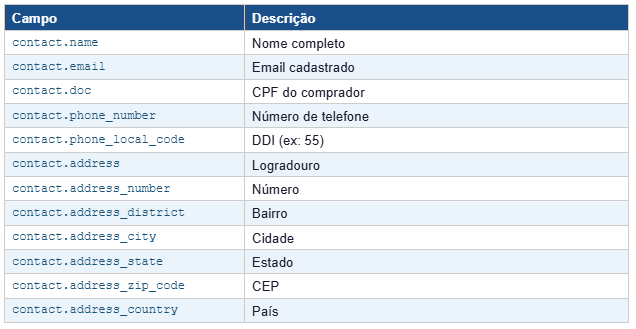
Dados do Comprador
5.2 Infrastructure Data
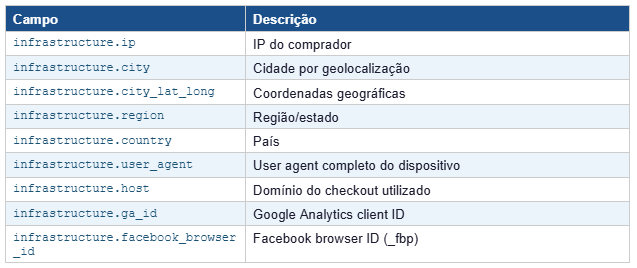
Dados de Infraestrutura
Technical and geographical information captured at the time of purchase: IP, city, geographical coordinates, region, country, user agent, checkout domain used, Google Analytics client ID and Facebook browser ID (fbp).
5.3 Detailed Financial Data
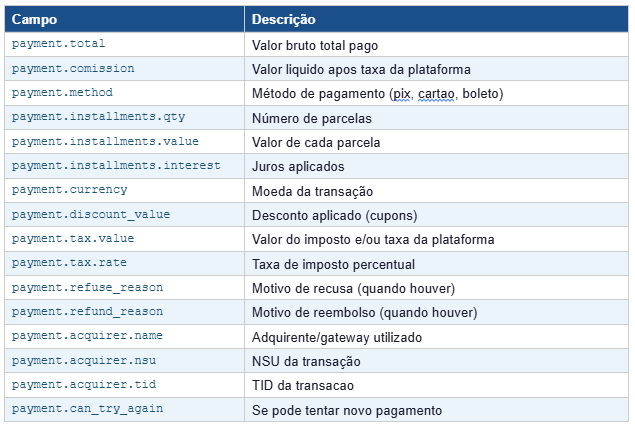
Dados Financeiros Detalhados
The payload exposes complete financial information: total gross value, net value after platform fee, payment method, number of installments, value of each installment, interest applied, currency, discount (coupons), tax/fee value, reason for refusal or refund, acquirer/gateway used, NSU and TID of the transaction.
5.4 Affiliates and Co-Producers
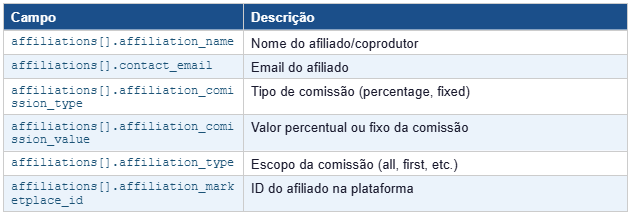
Afiliados e Coprodutores
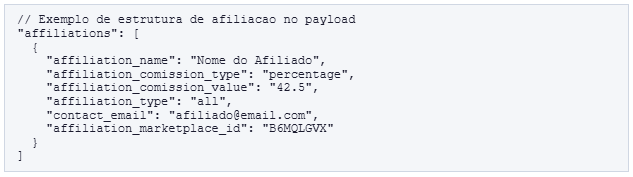
Visão do payload do Webhook contendo informações sobre Afiliados e Coprodutores
The payload lists all affiliates and producers participating in the transaction, with their respective commissions: affiliate name, email, commission type (percentage or fixed), commission amount, scope (all sales or first sale) and ID on the platform.
5.5 Product Data
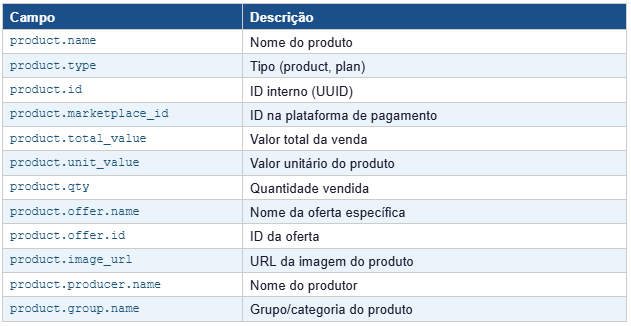
Dados do Produto
Complete information about the purchased product and the specific offer: name, type (product, plan), internal ID, ID on the payment platform, total and unit value, quantity, name and offer ID, image URL, producer name and group/category.
5.6 Separate and Organized Dates
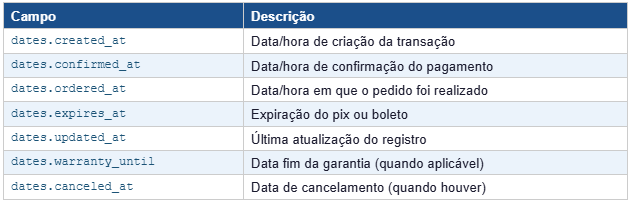
Datas Separadas e Organizadas
Payload organizes all relevant dates in a dedicated object: creation date, payment confirmation, order placed, expiration of the pix/bollet, last update, end date of warranty and date of cancellation.
5.7 Organized UTMs and Other URL Parameters
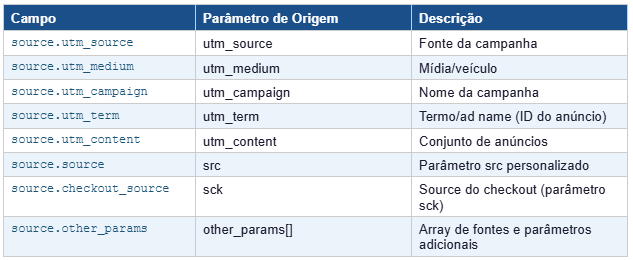
UTMs Organizadas e demais parâmetros de URL
The UTMs and other URL parameters of the purchase are mapped to a dedicated source object, separating the src parameter from the sck for maximum traceability:
- source.utm_source — Source of the campaign
- source.utm_medium — Media/vehicle
- source.utm_campaign — Name of the campaign
- source.utm_term — Term/ad name (add ID)
- source.utm_content — Set of advertisements
- source.source — Customized src parameter
- source.checkout_source — Checkout source (parameter sck)
- source.other_params — Array of sources and additional parameters
Important: the platform must register all URL parameters that arrive at checkout, not just fixed parameters. Several projects and companies use customized parameters in their URLs for database enrichment.
5.8 URLs for Abandonment Recovery
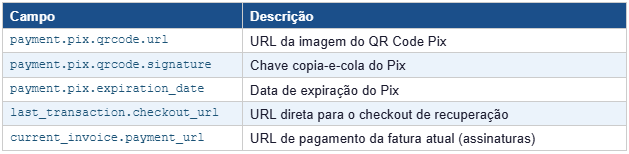
URLs para Recuperação de Abandono
For pending transactions (expired pix, unpaid billet, declined card), payload delivers direct URLs for reactivation: QR Code Pix image URL, Pix copy-and-glue key, expiration date, recovery checkout URL, and current invoice payment URL (signatures).
These URLs can be used in recovery automations: firing via WhatsApp, email or SMS with direct link to payment, without needing to generate a new checkout from scratch.
6. Subscription Webhook
In addition to the standard transactional webhook, the platform can have a specific webhook for recurring subscriptions, with complete data on the billing cycle.
Exclusive Signature Data
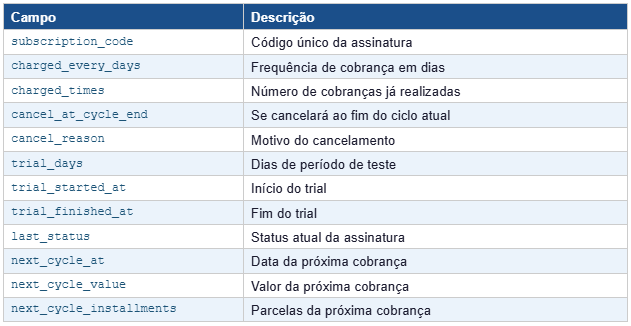
Dados Exclusivos de Assinatura
Single subscription code, billing frequency in days, number of charges already made, will cancel at the end of the current cycle, reason for cancellation, days of trial period, start and end of trial, current subscription status, date of next charge, amount and installments of the next charge.
Current Invoice Data
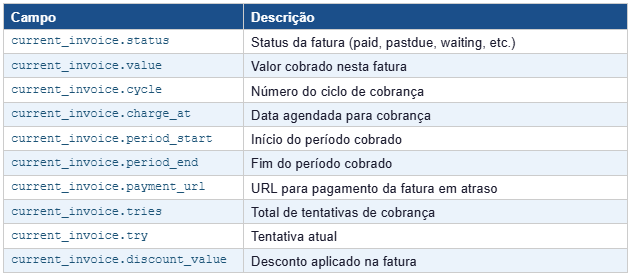
Dados da Fatura Atual
The current_invoice object brings the state of the current charge: invoice status (paid, pastdue, waiting), amount charged, cycle number, scheduled date for collection, beginning and end of the period charged, URL for late payment, total attempts and current attempt, discount applied.
Signature Status Flow
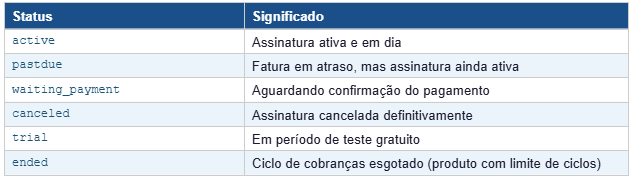
Fluxo de Status de Assinatura
The following statuses are transmitted via webhook throughout the life cycle:
- active — Active signature and up to date
- pastdue — Invoice in arrears, but signature still active
- waiting_payment — Awaiting confirmation of payment
- canceled — Definitely canceled signature
- trial — Free trial period
- edd — Depleted collection cycle (product with cycle limit)
The status pastdue allows you to trigger default recovery automations with contact data and payment URL available directly on payload, without additional queries to the API.
7. Use Cases and Integrations
Meta Conversions API (CAPI) via Server-side GTM
With a dataLayer and rich webhooks, you can implement the Meta CAPI server-side form: the purchase event is fired in the dataLayer with hasheado email, phone, IP and user agent. The sGTM hosts the event and forwards it to the CAPI with all match data. Result: High event match rate (Event Match Quality above 8/10) and redundancy of conversion tracking (customer + server ensure full coverage).
Google Ads Enhanced Conversions
The hashed data available in dataLayer is compatible with the Enhanced Conversions feature of the Google Ads: hasheaded email via SHA-256, phone and name hasheados, and the gclid preserved for correct conversion assignment.
Checkout Abandonment Recovery
With dataLayer shooting since form_start and begin_checkout, it is possible to identify users who started but did not finalize the purchase. The email can be captured as soon as you type in the field (begin_checkout already contains email). With this email, automation systems can trigger recovery sequences. For default subscriptions, the webhook delivers the ready-made payment URL.
Advanced Assignment with UTMs + sck
The combination of UTM parameters with the parameter sck (checkout_source) allows maximum granularity of assignment: utm_source, utm_medium, utm_campaign, utm_content and utm_term identify the campaign. The utm_term usually contains the ad ID (name_ad|ID_of the advertisement). The sck it allows the storage of more information than UTMs. This level of detail enables more robust optimization to the individual creative level.
Integration with CRM and Automations
The webhook can be sent to any endpoint of CRM, automation tool or proprietary system: ActiveCampaign, RD Station, HubSpot, N8N among others. Google Sheets spreadsheets via webhook + Apps Script. Own systems via API REST. Server of conversion tracking (sGTM) for server-side processing.