

Ads in ChatGPT can adapt target text and URL: what you need to review
OpenAI can adapt text, image and destination of the ads in ChatGPT. Understand the feature and see how to review message, pages, and measurement.

You approve a message for the ad, but the user can find a variation of it. A OpenAI describes a feature called creative enhancements: it uses the ad and content of the landing page to tailor title, description, language, image size, and in some cases the destination URL. Variations can be prepared before or created at the time of the conversation.
The configuration was enabled by default in 30 october of 2026 for new and existing campaigns of the self-servene and BPO model, according to OpenAI. Previous account or campaign opt-outs are preserved, and campaign setup prevails over that of the account. The change does not apply to accounts administered by a commercial team (sales-managed). This does not prove availability of ChatGPT Ads in Brazil or your account. Before planning a campaign, check out the access and options in your Ads Manager.
What can change in the ad
- Text: title and description can be rewritten to relate to the person's conversation and interest.
- Language: The message can be translated.
- Picture: the format may require resizing.
- Destination: the URL can be optimized to point to a relevant page of your website.
It is a powerful idea, but it brings a new responsibility: the page ceases to be just the destination of the click and starts to feed the message presented. If the page has an old price, a vague promise, or an overdue offer, that context can contaminate the variations. This is an operational inference from the function described by OpenAI, not a test taken on the author's account.
It is worth paying attention to the verb can. The documentation does not say that all ads will be modified, that every URL will be exchanged, or that the tool will create a new image. In the visual case, the possibility described is the resizing. For the destination, it talks about pointing to a relevant page of the site itself. What actually happened in a campaign needs to be observed in the account, not deducted from the list of resources.
Four review points: text (promise and price), language (sense of offer), image (cut and readability) and destination (actual page and measurement).
No Official example, a food delivery offer gets an essay about quick dinners for being that the topic of conversation. The offer follows the same, while the presentation adapts. It is a didactic example of OpenAI, not a guarantee that the variation will be the same for all users.
Review Map: approved ad + current landing page → possible variations of text, image and URL → click → effective page → conversion measured.
A closer example to our market
Imagine a company that sells an AI dashboard training. The original ad says “Learn how to build dashboards for marketing” and leads to the course page. In the same domain, there is still an old waiting list page and another that explains dashboards for campaigns. A conversation about measuring campaigns could provide context for a title variation. Since OpenAI also mentions destination optimization, the three pages deserve review.
That is a hypothetical scenario. I’m not saying that OpenAI would choose the old page or that the advertiser would have access to the context of the conversation. The example shows the problem we can control: if any public page receives a visitor, offer, form, and measurement need to be consistent.
I would ask five questions before turning on the feature:
- Should the old page still be in the air? Does the button lead to the correct place?
- Do the price, availability and bonuses match the current announcement?
- Does the specific page describe the same product or do you promise something different?
- Do the forms of the different pages use the same data contract and store the source?
- Can I connect visit, entry page and purchase on my own system?
A forgotten test page can be harmless in normal, problematic navigation as a campaign gateway. OpenAI recommends keeping an ad and landing page up to date, including pricing, promotions and availability. Page inventory is my practical application of this guidance.
Infographic of the path that needs to be audited
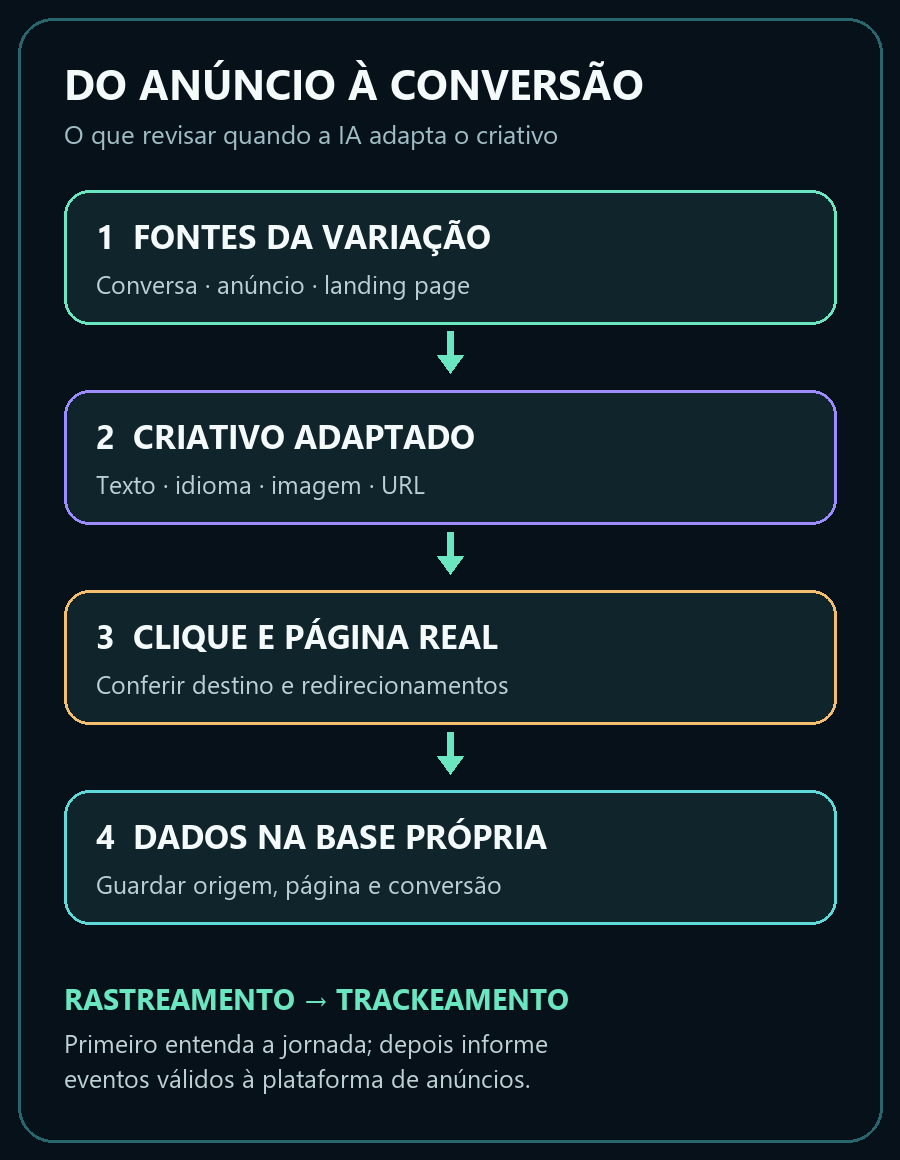
Infográfico: conversa, anúncio e landing page podem alimentar uma variação; conferir clique, página real, rastreamento próprio e conversão
- The conversation, ad, and landing page give context to the possible variation.
- The feature can adapt text, language, image and destination.
- The person clicks and arrives at a real page, which needs to be checked.
- The first-party data collection records this arrival at the proper base and relates the conversion to the route.
The top summarizes the entries and adaptations described by OpenAI. The bottom is the conference routine that I recommend. The drawing does not imply advertiser access to individual conversations or say that a variation will be made in every announcement.
Checklist for a campaign that uses automatic variations
- Check out the end-to-end offer. Title, description, page, price, availability and conditions need to tell the same story. OpenAI itself recommends keeping an ad and landing page up to date.
- Map the eligible pages. If there are old versions, test pages, or overdue offers on the same site, review whether they can appear as a relevant destination. Do not assume that the tool will always choose the URL initially inserted.
- Set brand and message boundaries. Be clear what is proven promise, what is just example and what terms do not describe your product. An automatic variation continues to represent your brand.
- Review the configuration. In Ads Manager, OpenAI indicates the Manage settings option to change the preference or exit the resource. Check out account and campaign; previous opt-out should remain.
- Validate the destination and measurement. Test the effective URL, redirects, UTMs, and final event in campaigns you actually have access to. The documentation talks about URL optimization; does not claim that UTMs are removed or preserved in all cases. This needs to be observed, not guessed.
- Track the result without hasty assignment. Impressions, clicks, spend, CTR, and assigned conversions appear in the report when available. A change in these numbers alone does not prove that the variations caused the result.
How would I run this checklist in practice
First, you would take an inventory of the domain pages used in the campaign: current landing pages, old versions, still-public test pages, and redirects. We do not know, by documentation, the exact list of URLs that the tool will consider in each situation. Therefore, the purpose of the inventory is to remove obvious contradictions from the site, and not try to guess the algorithm.
Then, it would compare the commercial truth on each page: promise, price, deadline, availability, bonuses and conditions. A phrase like “open registrations” needs to remain true in both the ad and the arrival page. I would ask someone who didn't create the campaign to read each combination without context. If I understand a different offer, I would correct the source before relying on the adaptation.
In art, it would check whether embedded texts remain readable in a smaller cut and whether the image continues to make sense outside of the original composition. The documentation cites resizing, not an unrestricted recreation. Still, a stamp or price within the image can become unreadable when the format changes. It would also review usage rights and the relationship between image and promise.
Then it would open Manage settings in Ads Manager and would record the effective campaign and account option. The previous opt-out must be preserved, but the campaign has priority over the account standard. Without recording this setting, a comparison of periods can mix campaigns with different controls.
Finally, I would test the click on mobile and desktop, checking the arrival URL, redirects, parameters that actually arrived, form and final event. The documentation does not state a universal rule for UTMs. If there is a URL change, it is precisely the test of the journey that will tell what the measurement structure has received.
Can I approve each version before I go on air?
The documentation says there is no preview of all variations. When the feature is enabled, they can automatically vehiculate without individual review. Therefore, the real decision is about the configuration of the resource and the quality of the source material: advertisement, pages and product data.
For those who work with first-party data collection, the practical question is: the click arrived on which page, with which source identification, and the conversion was recorded where? First save this route at your base; then enter the data to the ad platform according to the chosen structure. A beautiful panel with no link between click, page and sale does not solve this doubt.
Here, I use the terms with an important distinction: first-party data collection is to collect and store the data on the basis itself; conversion tracking is to collect and inform this data to the traffic platform. The first allows you to reconstruct the visitor’s journey with their own records. The second feeds the platform with valid events. A high event match note does not replace the verification of the page where the person entered and how the sale was recorded.
It would also separate the Ads Manager reports from the data itself. The platform can show impressions, clicks, spend, CTR, and assigned conversions when the measurement is configured. These numbers help keep up with the campaign, but a change in performance does not demonstrate the effect of creative enhancements alone. Budget, public, competition, seasonality and changes on the site also change the result. OpenAI itself makes this caveat in the documentation of the appeal.
What would I do before I activate
I would mount a small array with three columns: original message, pages that can receive the click, and observed variations. I would check each promise and take an end-to-end test of the visit to the conversion. If there is no access to these checks or if the brand requires literal approval from each creative, it would consider disabling the feature until it sets up a review routine.
This record can be simple. One line per campaign with the approved message, revised URLs, configuration status, date of the last conference, click test result and responsible for the offer already allows you to find out if a problem came from the creative, the page or the measurement. Without this separation, everything turns “AI has changed something,” a vague explanation that doesn’t point to a correction.
Frequently Asked Questions
Do the ads change the ChatGPT responses?
According to OpenAI, no. Announcements are separate and identified.
Does AI always change destiny?
There is no such statement. The documentation says that the URL can be optimized for a relevant page.
Do I lose the UTMs?
The source does not say that. It's a QA point in the actual campaign: check the arrival URL and data captured before drawing a conclusion.
Is it available in Brazil?
The document consulted does not prove availability by country or access to the author's account.
How to shut down?
OpenAI guides you to change the preference in Manage settings in Ads Manager; existing opt-outs are preserved.
Source: OpenAI Help Center, Creative enhancements for ChatGPT Ads, consulted in 05/11/2026.